Category: Essays

  • Insignificance

    Insignificance

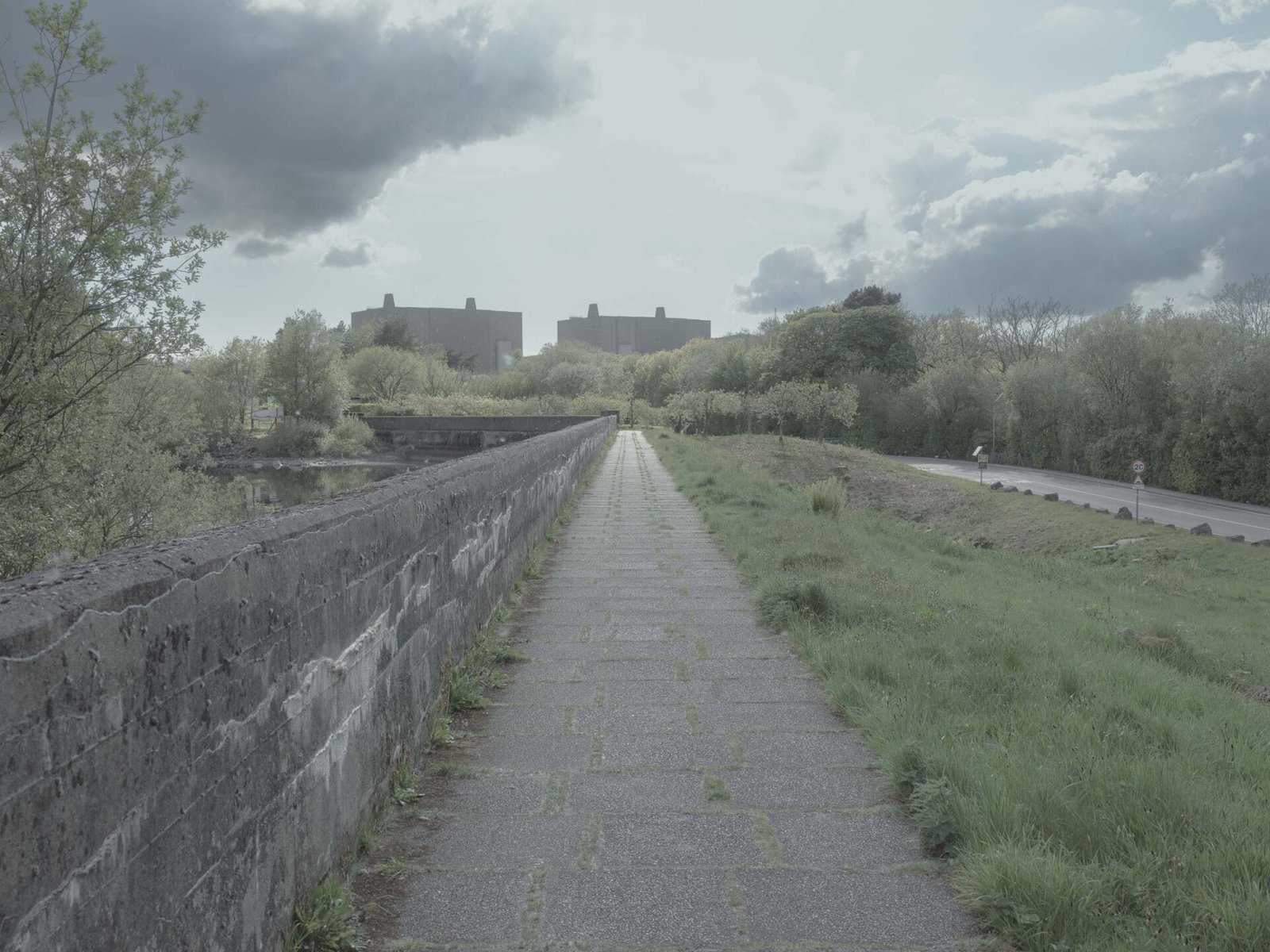
    Stone causeway leading toward the decommissioned Trawsfynydd nuclear reactors, Eryri National Park, Wales
    Causeway approaching the twin reactors

    I had come to Eryri to spend some time alone and recharge; to walk and to make photographs. I left a little more conscious of my place in the world than when I arrived.

    I knew, as part of my trip, I wanted to spend some time around the now-decommissioned Trawsfynydd nuclear reactors. These twin Magnox reactors, constructed and operational from 1965, are unique in the UK in that they are the only nuclear reactors built in a national park. I wanted to explore how they had impacted the environment here, what relationship they had to the beauty that surrounds them.

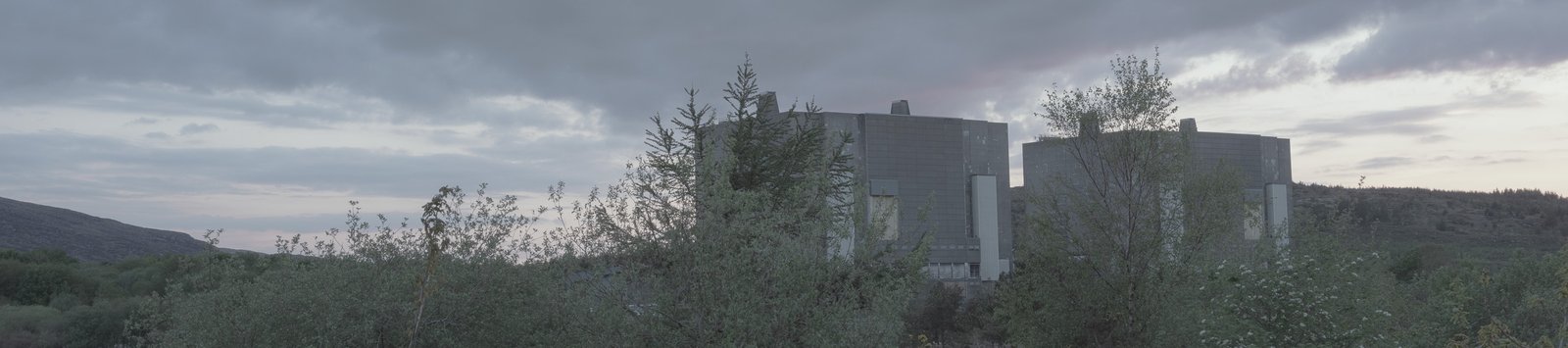
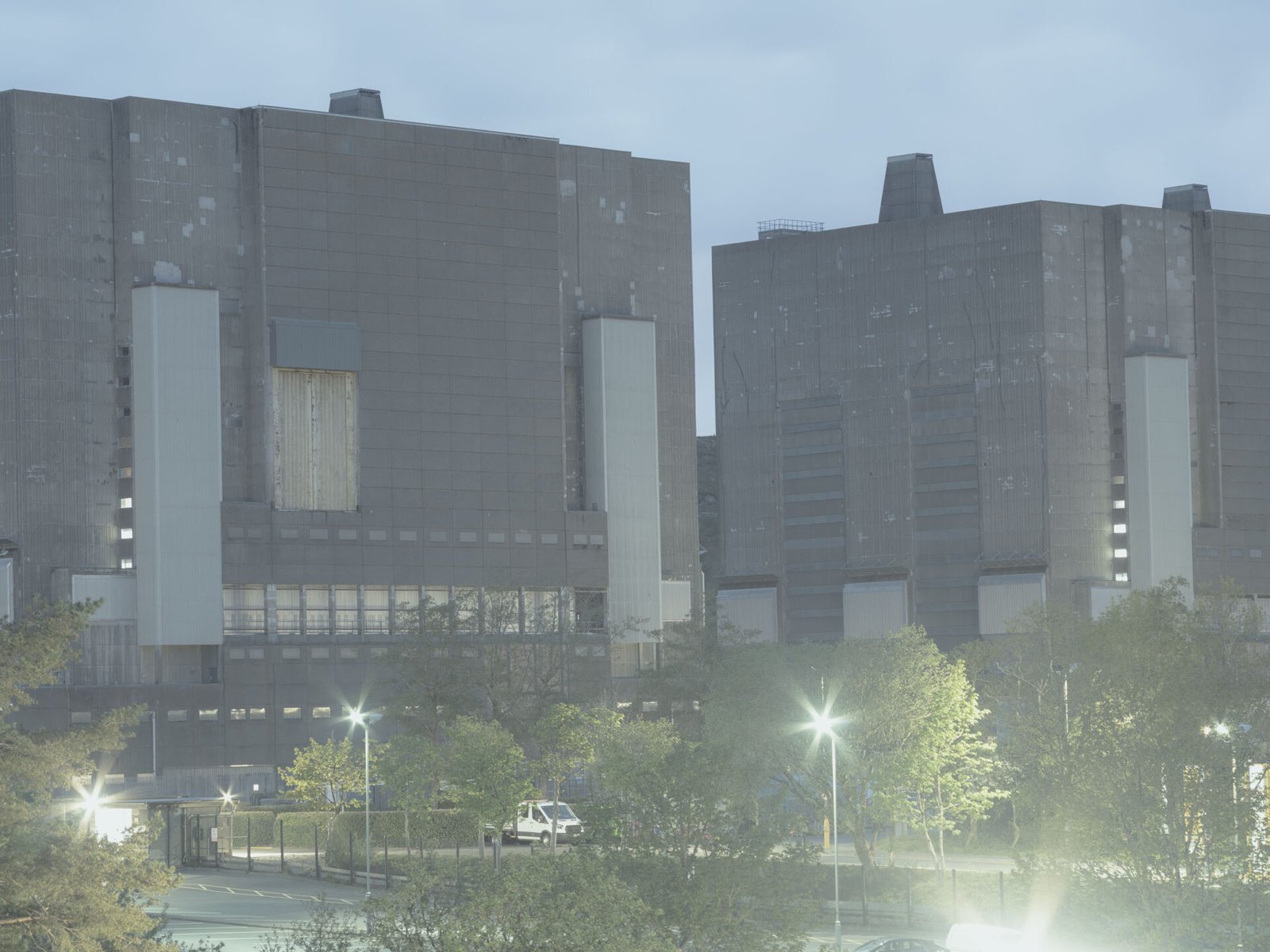
    Approaching the reactors for the first time, there was a familiarity to the brutalist concrete megastructures that loomed in the foreground of my car windscreen. They follow the same aesthetic as Sizewell A and Dungeness A, both reactors closer to home and that I have photographed before. Here though, there are two of them. A pair of concrete twins, birthed as slaves to our energy demands and now standing as fading monuments to our engineering hubris.

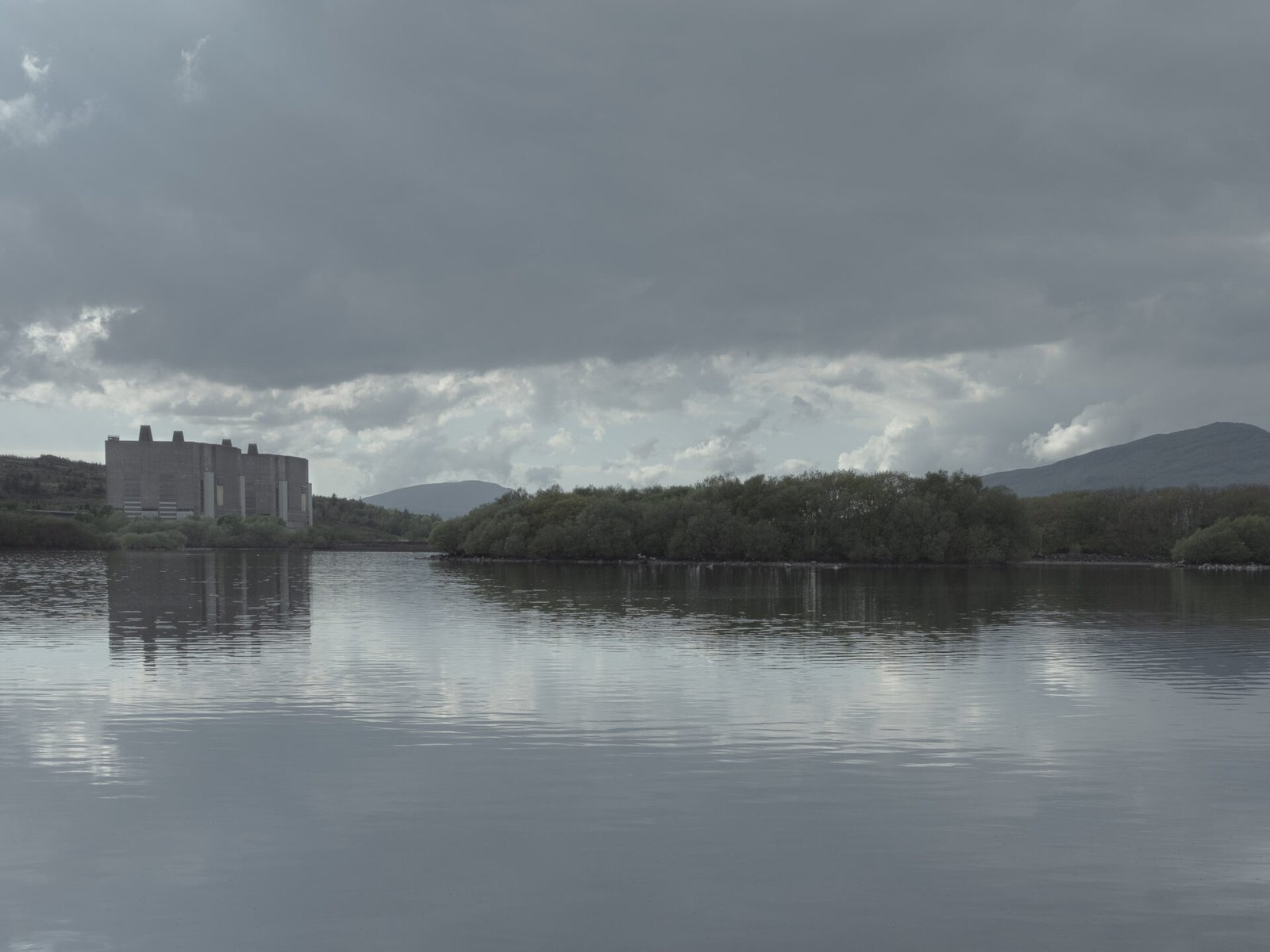
    Trawsfynydd nuclear reactor reflected in the still water of Llyn Trawsfynydd with mountain backdrop, Eryri
    Llyn Trawsfynydd

    The reactors sit on the banks of a manmade lake – Llyn Trawsfynydd. The lake came decades before the reactors (flooded from 1924 to 1928), created by one of four dams that were built to serve the hydro-electric power station down the valley at Maentwrog. Viewed from just around the Llyn, the reactors actually settle neatly into the landscape, their huge scale somehow more manageable seen as reflections on the Llyn and against the huge mountain vistas of Snowdonia.

    The next day I took a walk around the Llyn’s perimeter to get a greater sense of how they sit in the context in which I found them. The weather was kind on the days I was in Wales, but the skies still had a sense of potential menace in them. This only adds to the drama of the landscape, the sky somehow a mirror of the rugged and wild moorland and mountains around me.

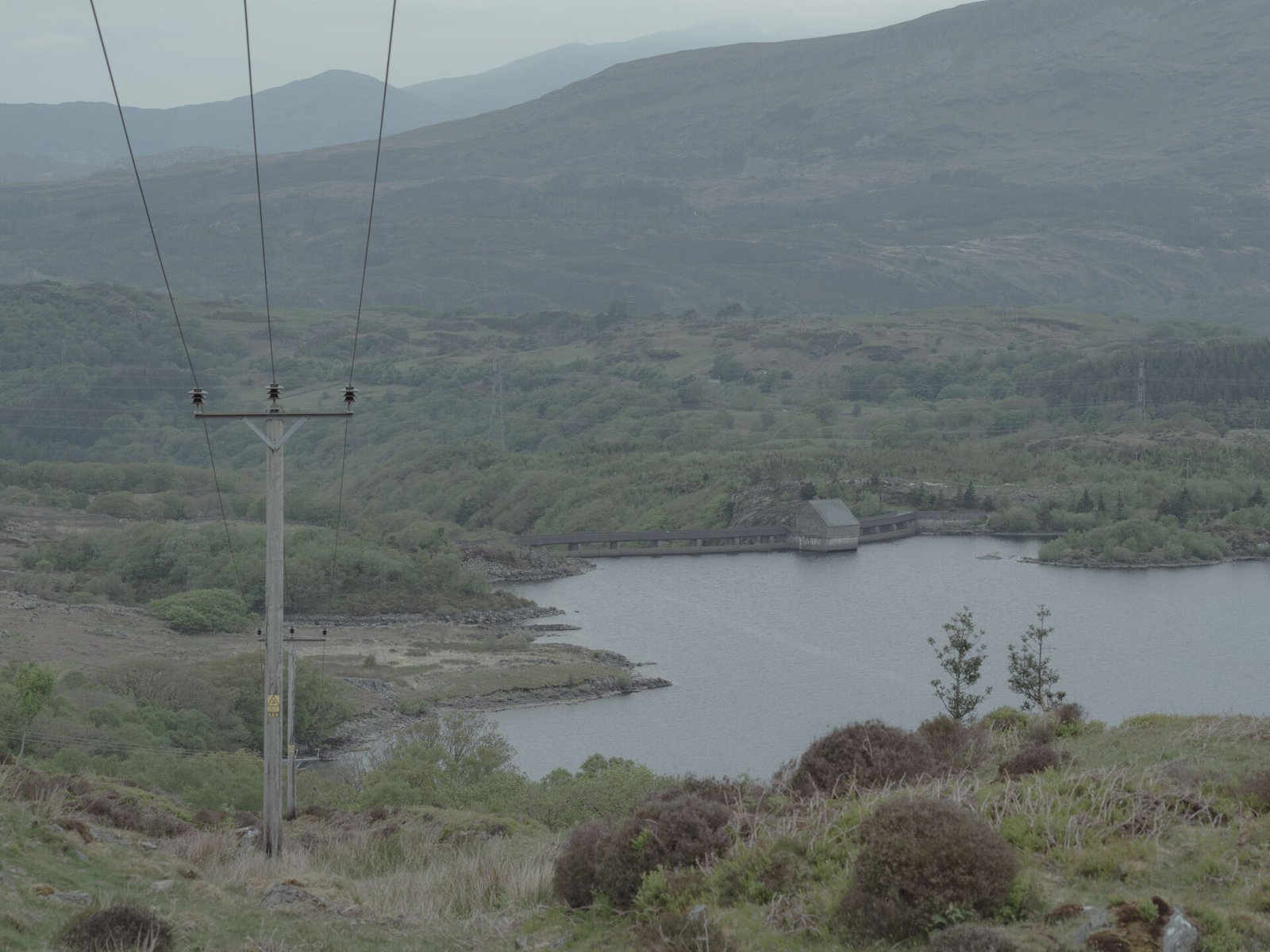
    As you walk around the lake you come to a dam. It was a strangely quiet scene. The scale of the dam is impressive but the low water levels in the Llyn meant that there was no sound of gushing water flowing down the valley towards the hydro-electric power station. The dam seemed suspended in time, its smooth concrete edifice on the downward side and majestic supporting arches a marvel of early twentieth century engineering.

    Electricity pylon in foreground with the Maentwrog dam and reservoir visible in the valley below, Eryri
    Dam on Llyn Trawsfynydd

    The dam felt like a remnant from a previous age when hydro-electric power was thought to be the answer to our energy needs, yet the irony is that it has outlasted the nuclear reactors. They stopped producing electricity in 1993, and it is the revenue generated from the energy that the hydro-plant produces that is funding the decommissioning of the nuclear reactors.

    As I walked further around the Llyn to Cwm Moch on the opposite bank to Trawsfynydd I found myself mulling over this strange quirk of fate – the old technology funding the clean up of the newer technology. And what a clean up operation it is. A public information board near the site informs you that 99.9% of the spent radioactive material has been recovered and stored in an intermediate waste store on site. The site is now in a care and maintenance phase. The waste will be moved if and when a national waste repository becomes available, with final site clearance expected towards the end of this century.

    I let this timeline sit with me for a while. Thirty odd years of generation, over one hundred years of clean up. Compare that to the hydro-electric scheme that now funds the clean up – still going over a century after commissioning. No waste produced with a yet unspecified final home.

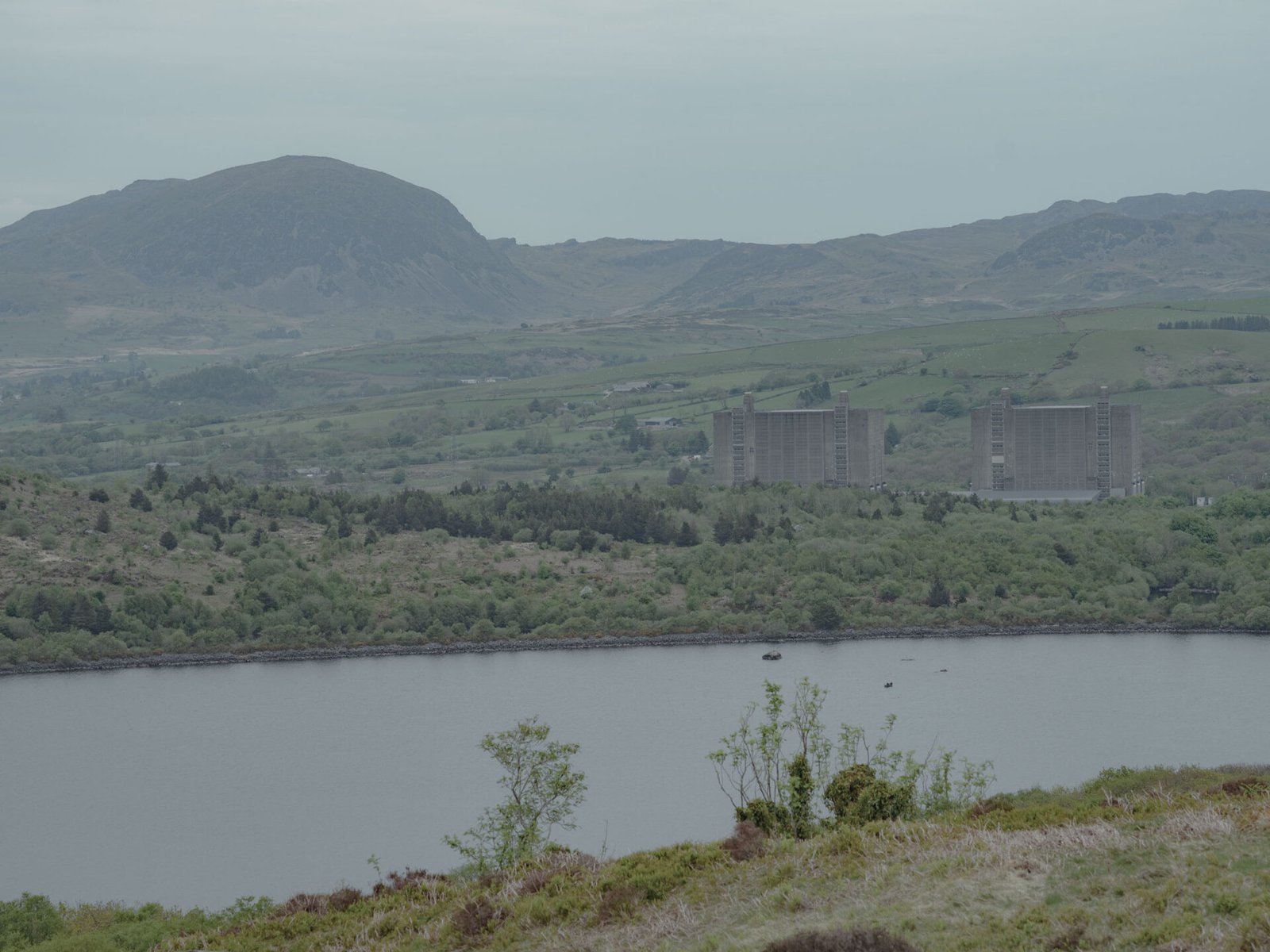
    As I looked through my viewfinder across the large expanse of the Llyn, I asked myself what this landscape will look like when the twin concrete shells of the reactors are finally pulled down. Viewed from a distance there’s a majesty to the reactors. I felt a lingering sense of admiration for the beauty of the structures. They somehow feel more at peace with their surroundings here than the other reactors I have visited. The electricity pylons that funnel out from them in neat parallel lines across the mountains don’t feel as obtrusive as I thought they would.

    Trawsfynydd nuclear reactors seen from Cwm Moch across the Llyn, dwarfed by the surrounding mountains of Eryri
    View across the Llyn to the reactors

    Putting down the camera and just pausing to take it all in I felt reinvigorated. Eryri stirs your soul. When you are in a place as beautiful and epic as this you cannot help but be awestruck. The space, the scenery, the mountains, the air remind you that the first world problems of our daily grind are insignificant in the sweep of human history and especially in the grand scale of geological time. Our everyday stresses and anxieties, our selfish ruminations and preoccupations with ourselves all feel irrelevant. You realise how small you are.

    And maybe that’s why the reactors, the dam, the pylons – which should all feel alien in this stunning landscape – somehow don’t feel out of place. It’s a scale thing. These structures are swallowed up by what surrounds them. They are present but not dominant. They don’t feel out of place because, just like me, they are insignificant.

    Yes, it will take the rest of this century to remove the last remnants of the reactors. But the mountains were here for millions of years before they were built, and they will be here for millions of years after they have gone. Sat on the side of Cwm Moch looking across the Llyn at Trawsfynydd A and B, that was a deeply comforting thought.

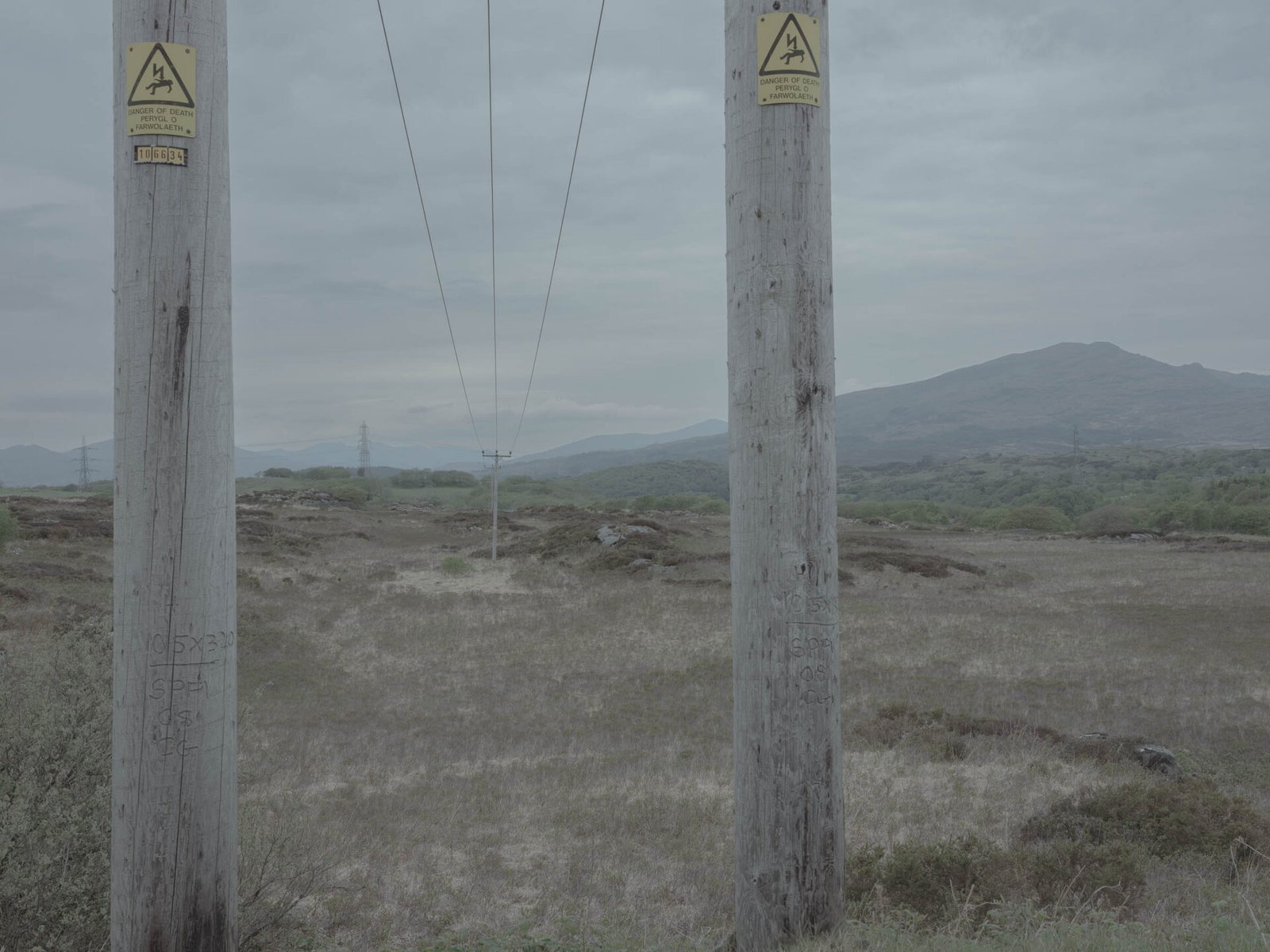
    Bilingual English and Welsh danger of death signs on electricity poles with pylons receding across moorland, Eryri
    Pylons stretching across the moorland
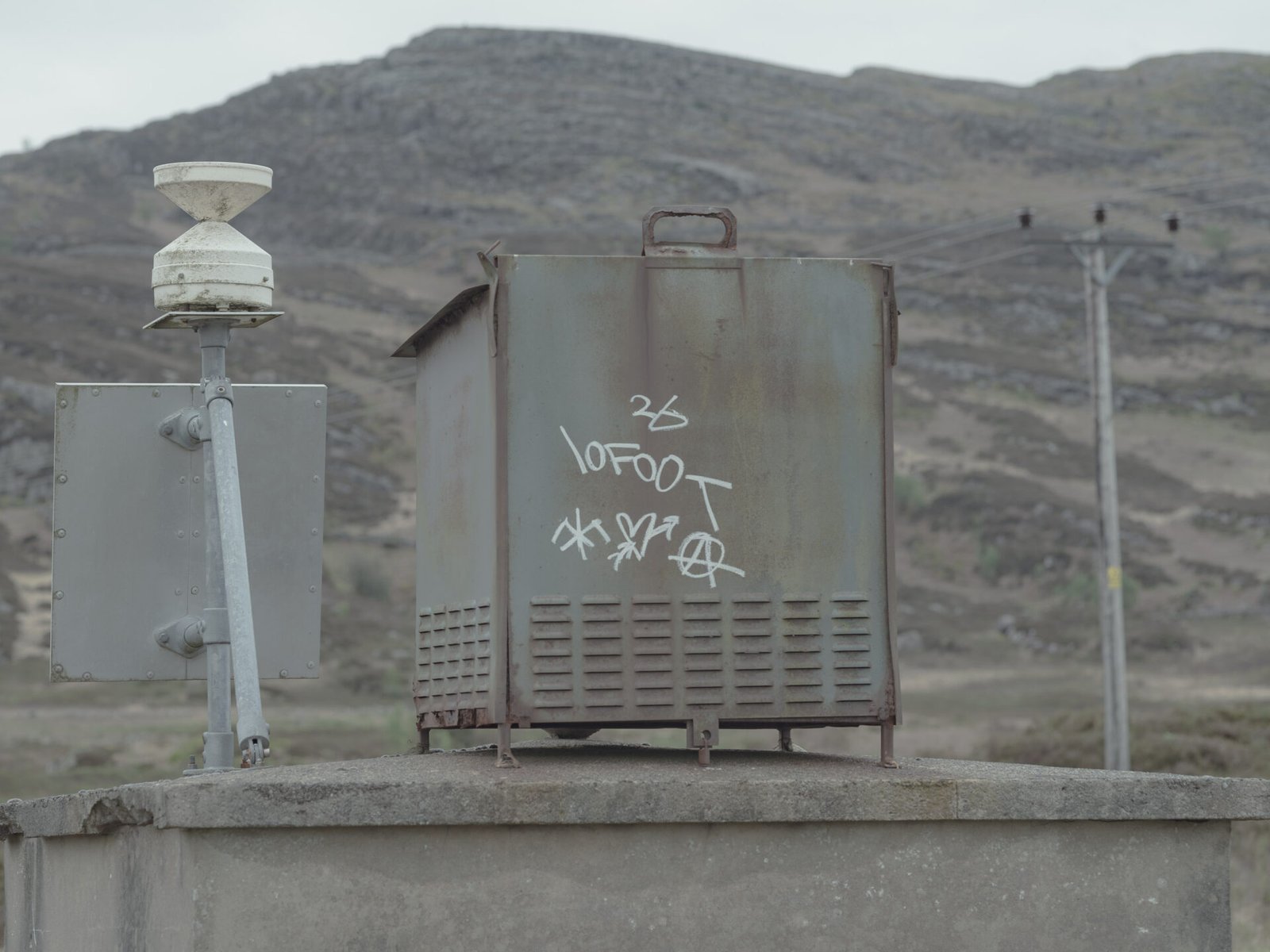
    Rusted nuclear monitoring equipment with graffiti on concrete plinth, bare mountain behind, Trawsfynydd
    Monitoring equipment
    The twin Trawsfynydd Magnox reactor buildings at dusk with security floodlights illuminating the base, Eryri
    The twin reactors at dusk
  • Underwhelm

    Underwhelm

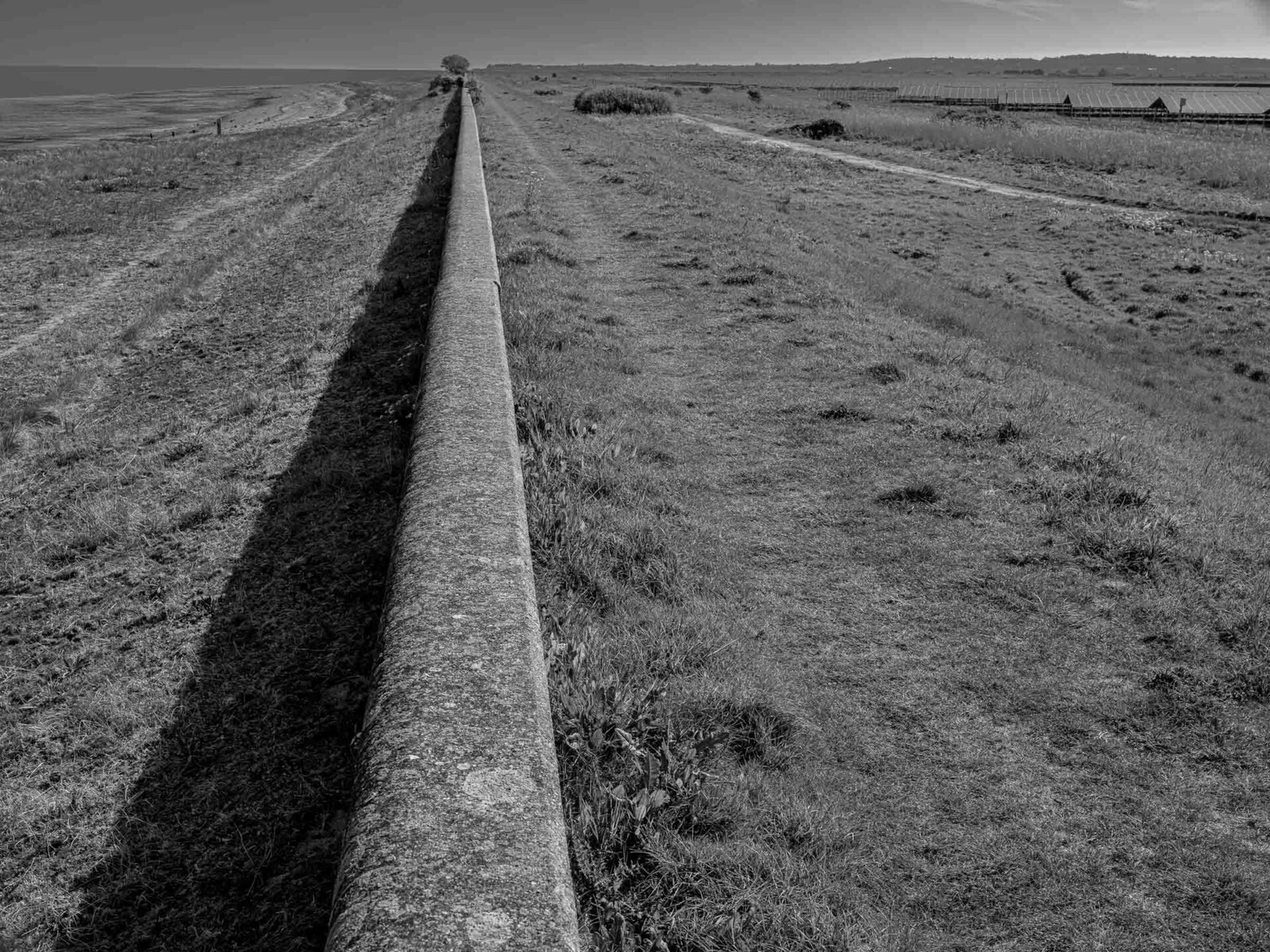
    Black and white photograph of a concrete sea wall dividing coastal marshland from Cleve Hill Solar Park, Kent, with the Swale estuary visible on the left horizon
    Sea wall

    One sunny Saturday morning a few weeks ago I found myself driving towards the east Kent coast to visit Cleve Hill Solar Park which claims to be the largest solar farm in the UK. As I drove the hour or so to the coast I wondered to myself what I would find. Would the scale take my breath away? Would I feel hopeful that here – on some low-lying marsh land in the Garden of England – I was seeing tangible evidence of our energy transition, of our gradual but accelerating move away from dependence on fossil fuels?

    However, as it turned out the experience left me a little frustrated and more than a little underwhelmed.

    Cleve Hill was not that easy to find. Unlike the huge looming presence of the nuclear reactors I’d previously visited at Sizewell or Dungeness, you cannot see a solar panel field from a big distance on low lying flat land. Furthermore, they tend to have been developed on what was previously private farmland in pretty rural places so require a little bit of persistence to find. My reliance on Apple Maps inevitably took me to a dead end single track lane. A bit of cursing and three point turning later, I eventually retraced my way back down the dead end road and decided to head out to the coastline as I knew there was a footpath along the seafront that separated the solar panel farm from the sea wall.

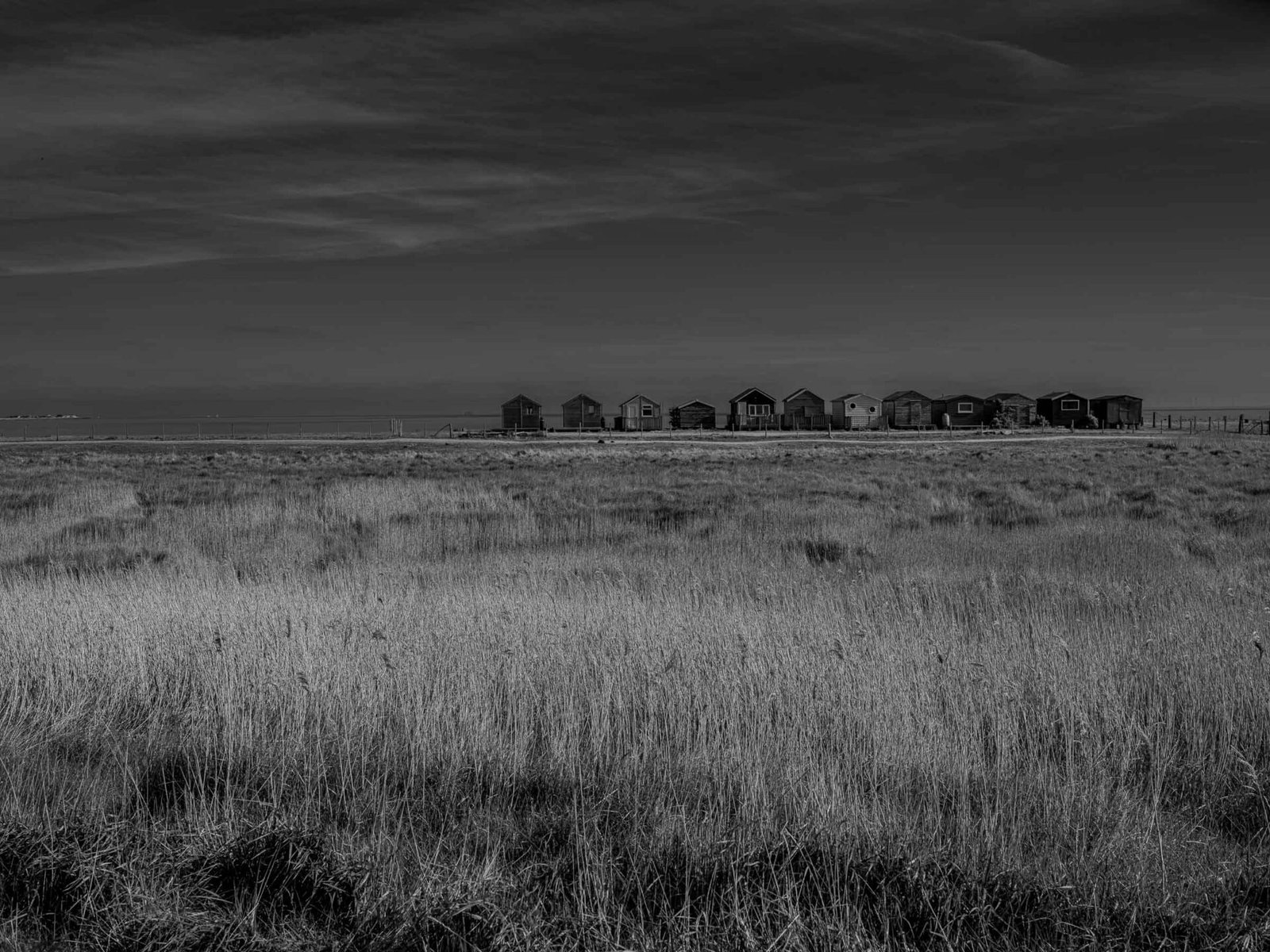
    Black and white photograph of beach huts on the Swale estuary shoreline, Kent, with dark dramatic sky above coastal marshland
    Beach huts

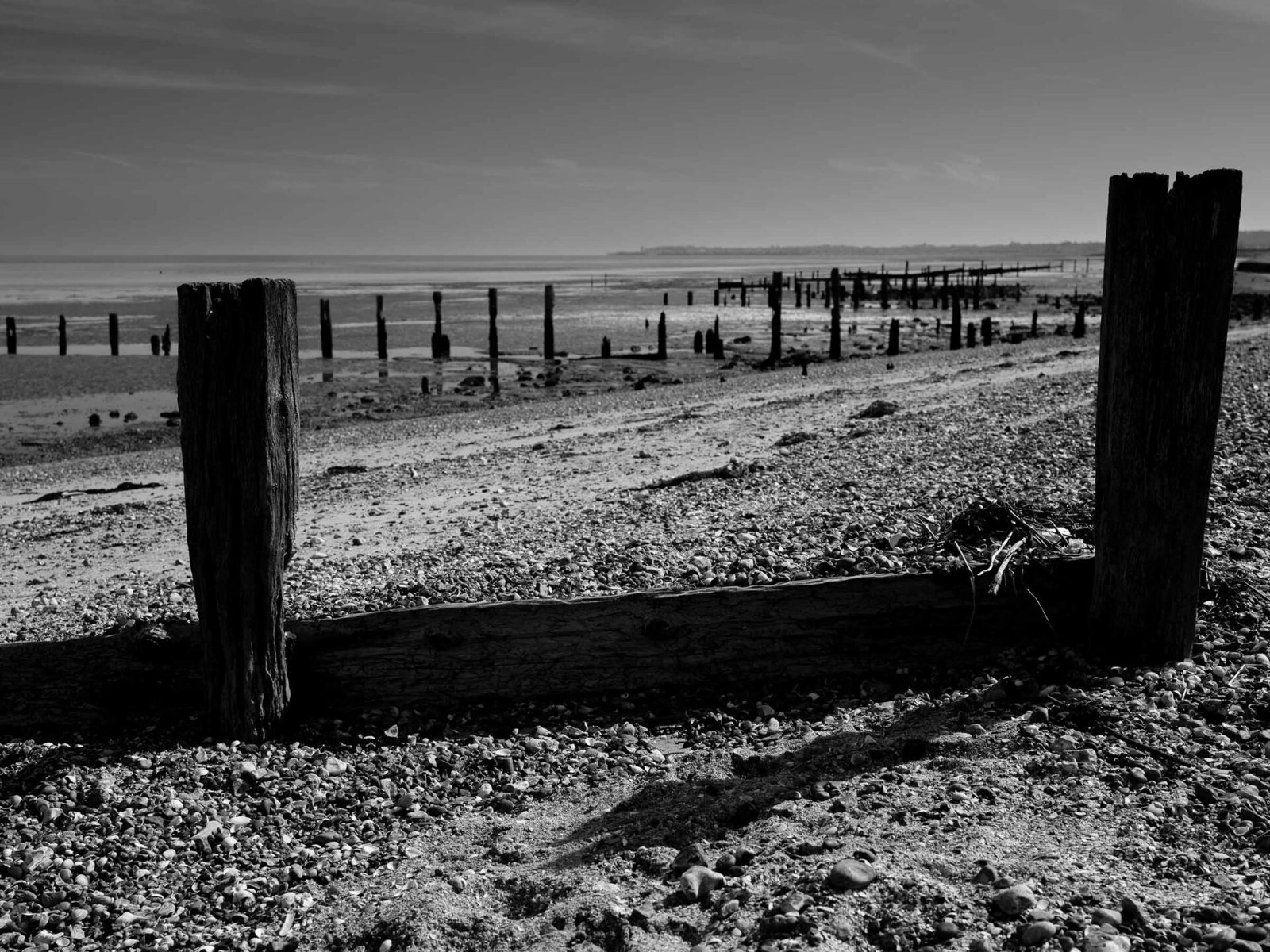
    Parking by the coastal path I headed out on foot. It was simply the most beautiful still spring morning possible. The sea – strictly speaking The Swale which separates The Isle of Sheppey from mainland Kent – was retreating at low tide but you wouldn’t know it. The surface was like a mill pond such that any tidal retreat felt like it must have been taking place by osmosis rather than the motion of the water itself. A very light spectral haze floated across the surface. Looking out south over the sea wall I could just about make out the Kentish Flats Wind Farm at the point where the haze of the sea horizon melted into the haze of the early morning sky. My only company was the excited morning chatter of various estuary birds announcing to anyone that would listen what a beautiful, glorious morning it was to be alive.

    Black and white photograph of decaying wooden groynes on the Swale estuary at low tide, Whitstable visible on the distant horizon
    Swale estuary

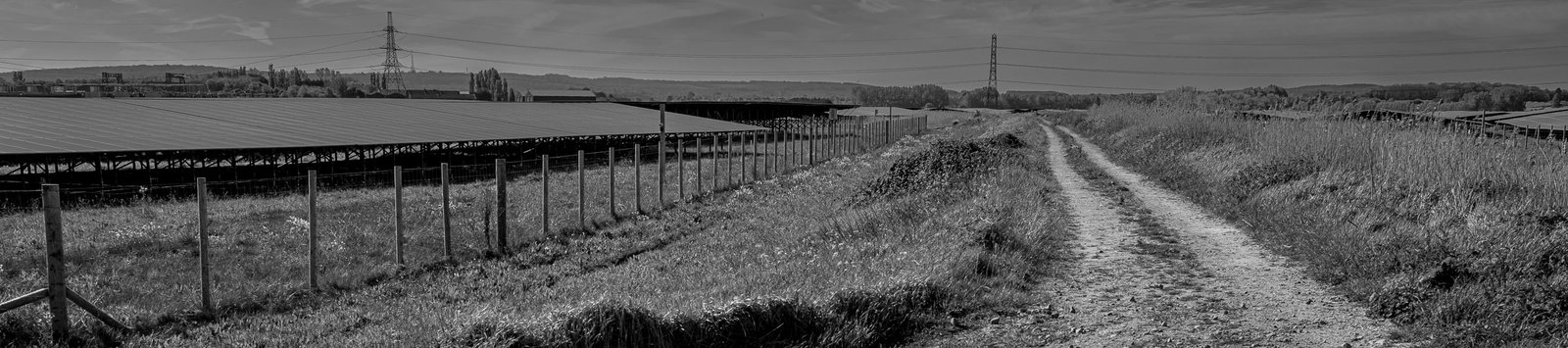
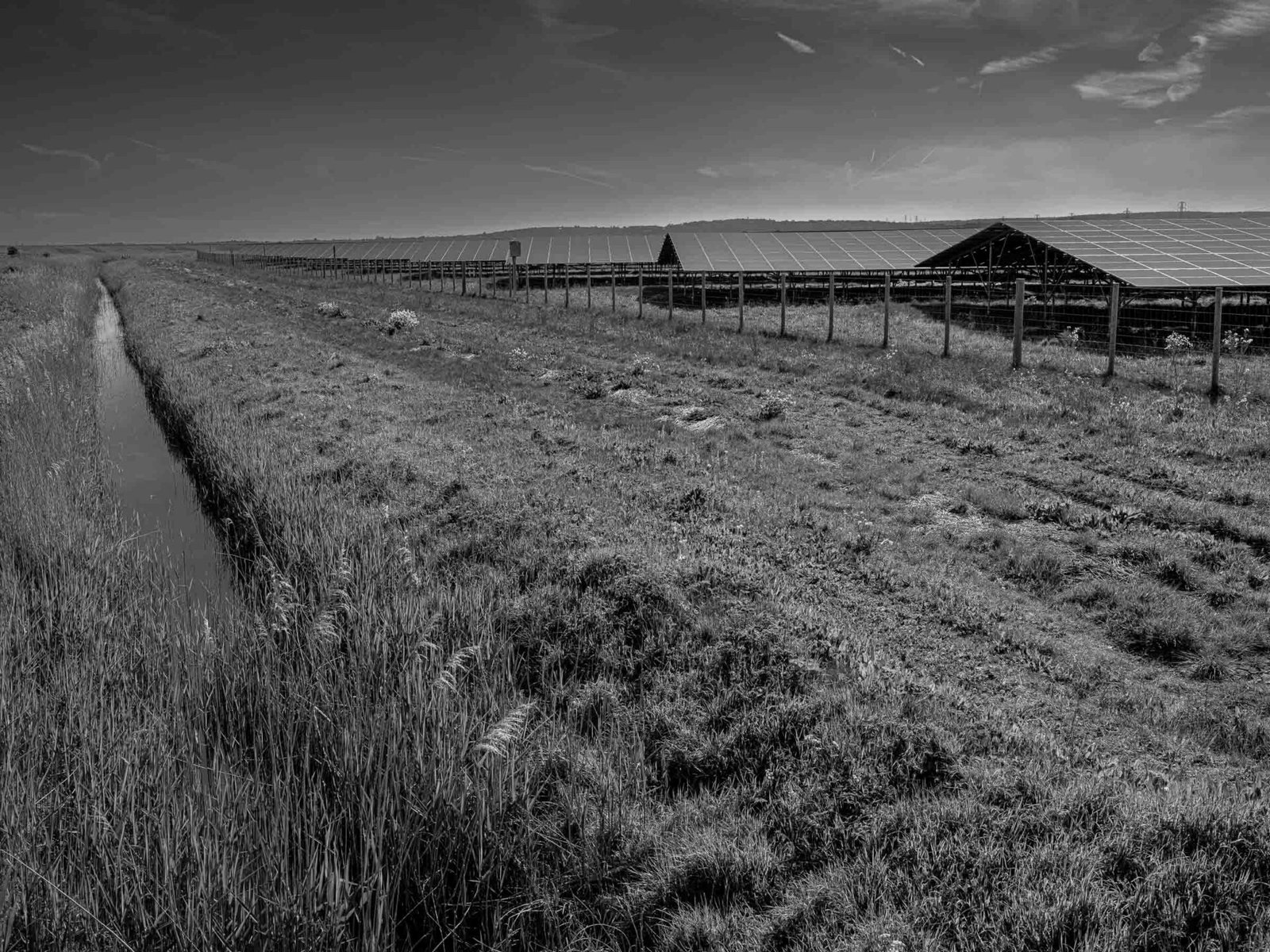
    Eventually as I walked along the path I could see the solar farm on the horizon. Getting closer, the panels began to take on an ethereal luminescence all of their own as they reflected the glow of the early morning sun, sucking in its energy. Closer still and I began to see the regimental rows stretching away from the coast, their uniformity on the horizon only punctuated by the emergence of an electricity carrying pylon or two, transporting the precious energy created on the farm out and onto the grid, a small stream helping to quench the thirst of our never-ending demand for energy.

    Cleve Hill produces 373 megawatts of electricity, that’s enough clean fuel to power just over 100,000 homes. It covers a piece of land about the size of a small English market town – think Ludlow or Ely. It is the UK’s largest solar farm and, as a result, has been designated a nationally significant infrastructure project.

    Black and white photograph of solar panels at Cleve Hill Solar Park viewed across a drainage channel, Kent marshland
    Cleve Hill Solar Farm

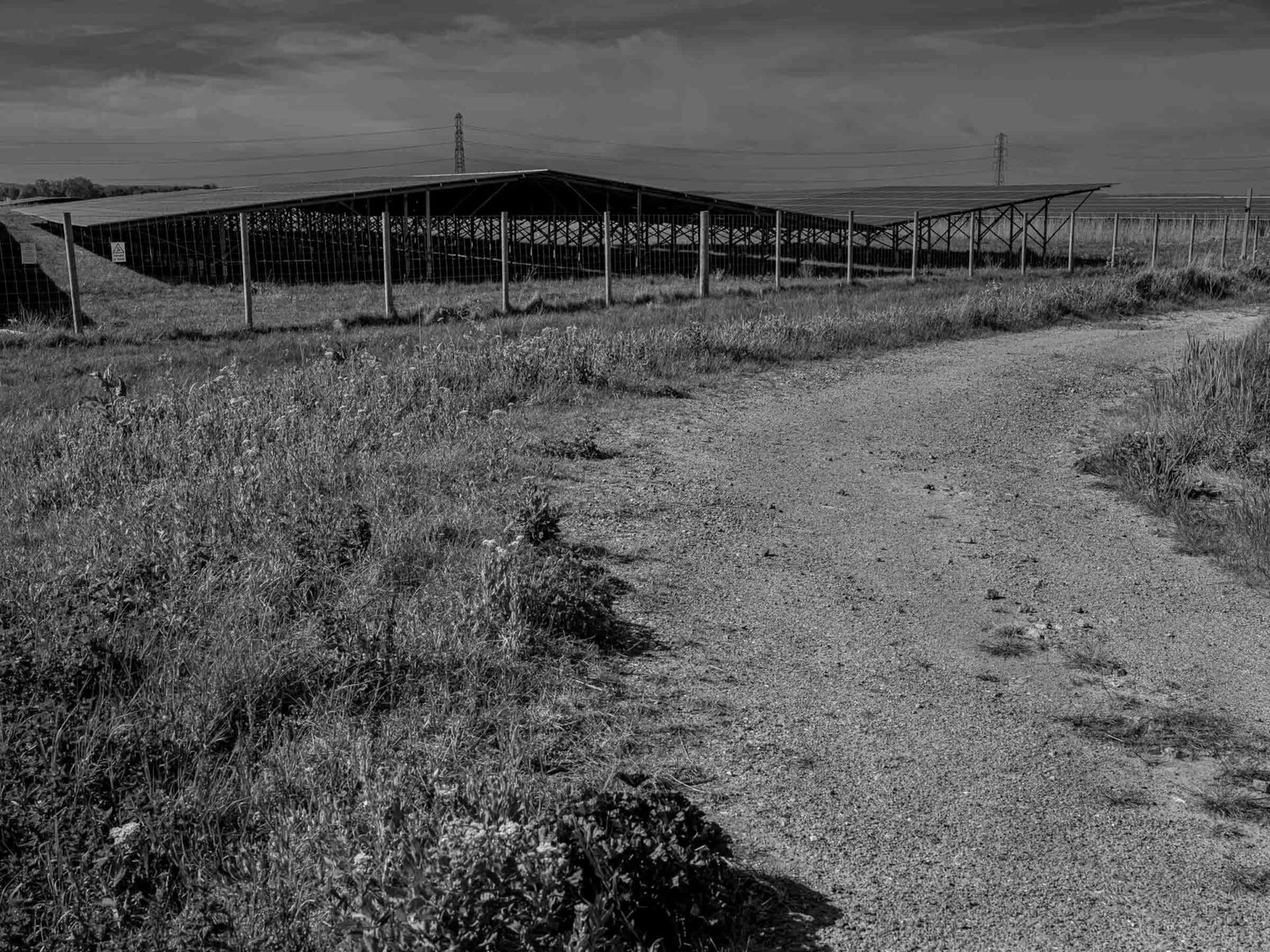
    However, whilst the scale feels undoubtedly impressive, the lack of a natural vantage point means it is not that easy to capture through a camera lens. Furthermore, there’s another issue – it’s simply not that easy to get that close to the panels themselves. The site – privately owned – is fenced off with lots of signs warning about danger of death from high voltage equipment punctuating the perimeter fence.

    Nevertheless, you are able to get just about close enough to understand the size of each of these solar panels. You could comfortably pass underneath one at the point at which one of its edges reaches up towards the sky. Each panel is the size of the roof on a typical semi-detached house. I could imagine walking under the array to feel not unlike how it would feel to walk along a street but passing from home to home through each house’s eaves.

    However, my overwhelming feeling at this point of the visit was one of frustration – at how difficult they were to find, and that I couldn’t get close enough or get a decent enough vantage point to really understand what you were looking at, to really understand and capture through my lens the impact this undoubtedly huge site has on the place in which it is located.

    Black and white photograph of the perimeter fence at Cleve Hill Solar Park with pylons visible behind the solar array, Kent
    Solar panels

    Despite its proximity to the tidal marshes of The Swale – a site of special scientific interest because of the diversity of wildlife to be found there, the site felt strangely sterile. There were no birds and insects darting around the panels, no wild flowers to be seen on the grass that carpets the ground beneath the panels, no sound of bees buzzing around doing their thing. In fact it felt slightly eerie and quiet – so much so that maybe I imagined that the panels themselves were emitting a background hum as they hoovered up the Sun’s boundless energy.

    I couldn’t help but contrast how this site felt compared to what I’d found in the area surrounding Dungeness power reactors, an RSPB reserve, teeming with water birds and those that use the reserve as a stopover on their migrations.

    And this is one of the trade-offs we will have to negotiate. Solar farms will need to be developed on a monumental scale for the UK to fully transition away from carbon. By one estimate we’d need about 280 Cleve Hills to fully replace fossil fuels in our energy mix (that’s before you start accounting for the seasonal variation in output of solar and the energy storage conundrum).

    Covering swathes of the country in these shiny, silicon panels may well come at the expense of wildlife and some of our precious ecosystems and habitats. To be fair to the developers of this site they have worked with the Kent Wildlife Trust to think about how biodiversity can be encouraged back to the site after construction has finished. Perhaps if I came back here in a few years it would feel different.

    As I walked further along the periphery of the site, I found myself contemplating what this solar farm represented. Was this a glimpse into the future, a future where large chunks of our open space are covered in shiny, luminescent photovoltaic cells (or of course large wind power turbines)? And yet, unlike nuclear generators or wind farms, there is no brutalist architecture that forces you to admire or be repulsed, there are no majestic blades that demand you take a position on how a field of turbines destroy or complement a view. The solar farm is just there in its uniform neatness, present and producing, but somehow sterile and slightly soulless.

    I realise this is entirely a photographer’s view of the world. I’m perhaps more selfishly interested in aesthetics and the feel of a place than its purpose. But I was struck by an irony as I walked back to the car. Dungeness, a nuclear power station — perhaps the most feared and contested form of energy generation we have — sits at the heart of one of the most biodiverse nature reserves in the UK. Cleve Hill, a solar farm, sits beside a wildlife sanctuary yet feels sterile and lifeless. We are building this future to save our planet. But how natural it will feel when we get there is another question.

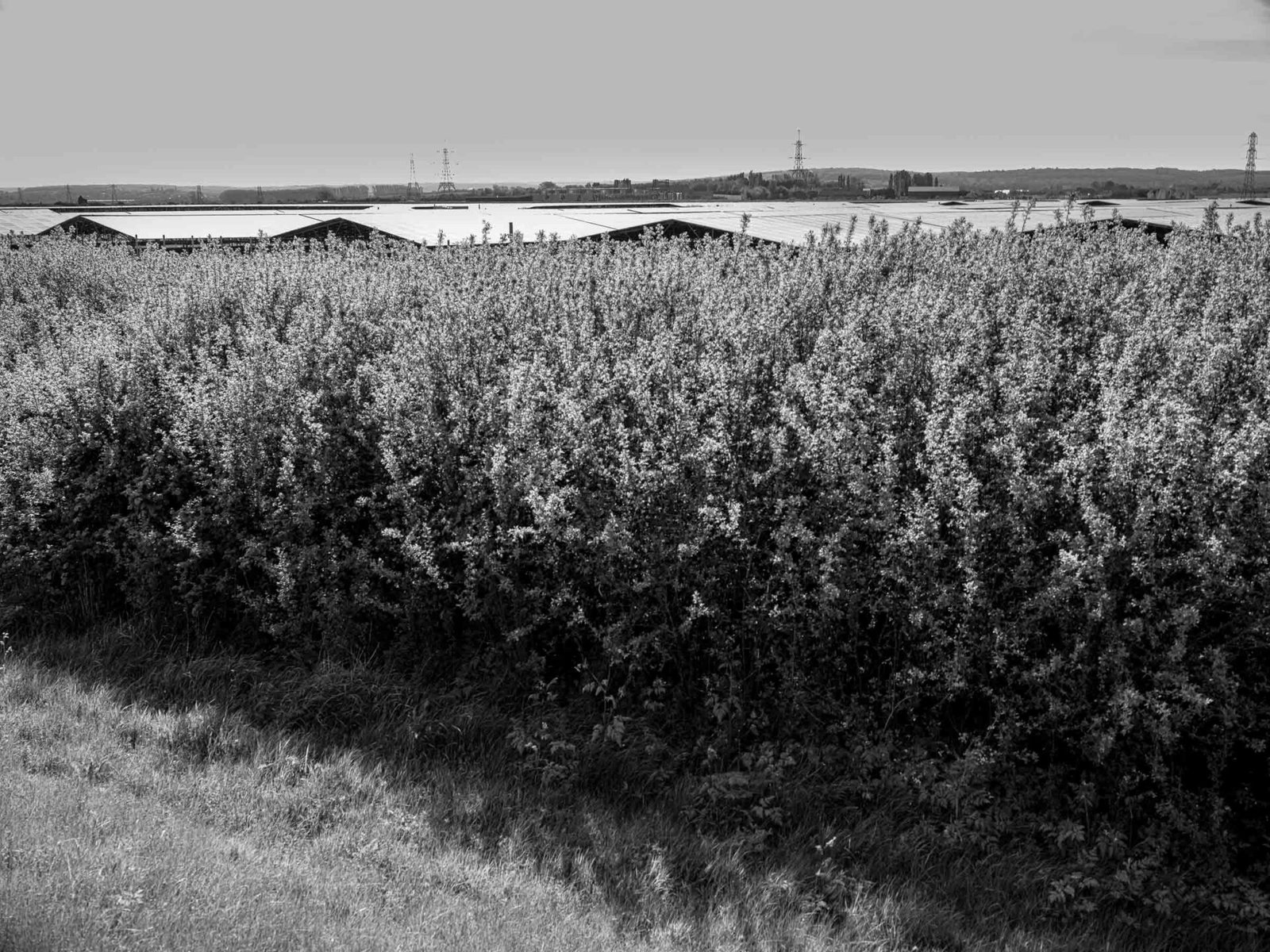
    Black and white photograph of flowering hawthorn hedge in front of Cleve Hill Solar Park with electricity pylons on the horizon
    Cleve Hill Solar Farm
  • Ruins

    Ruins

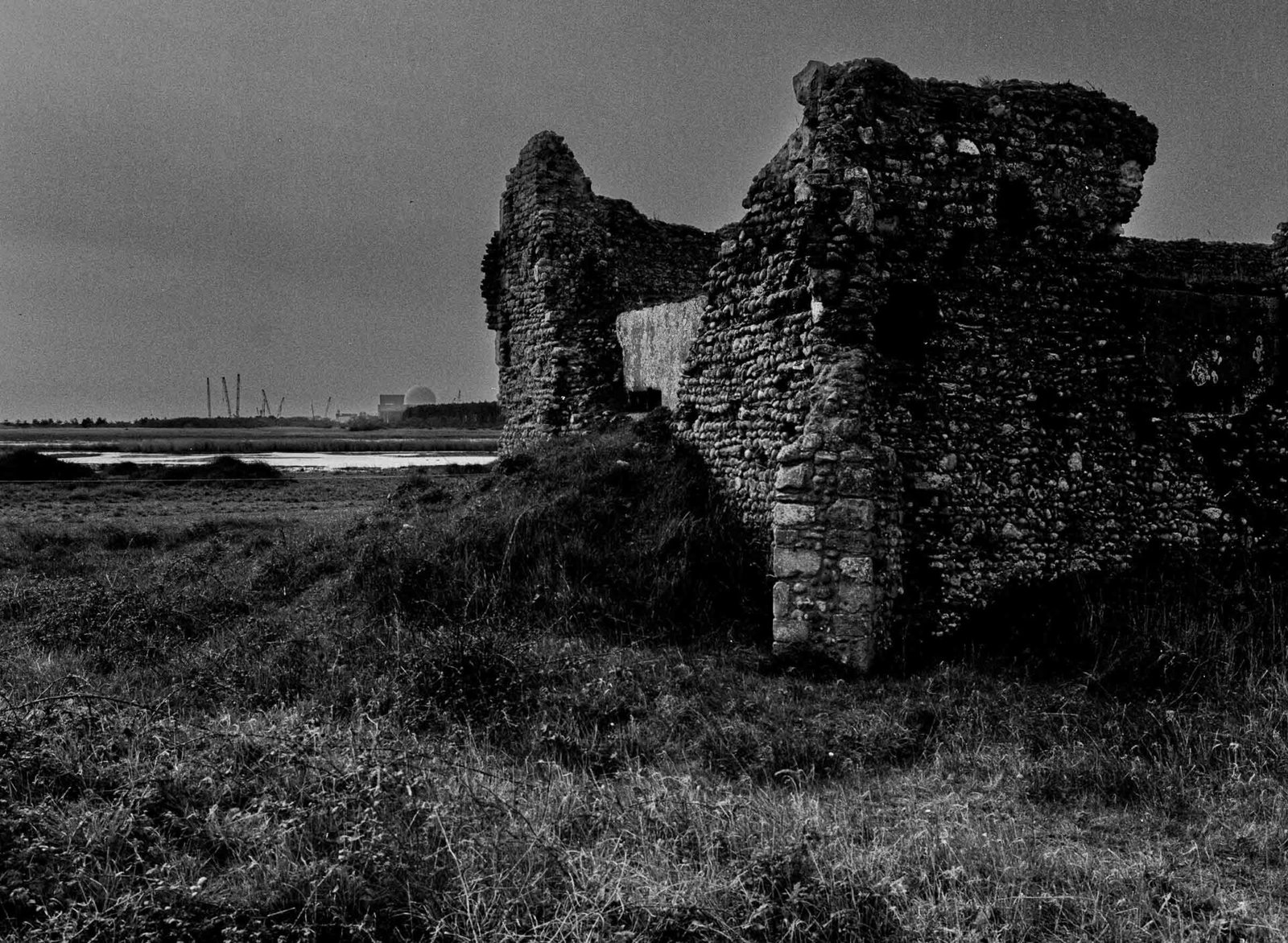
    The ruins of Leiston Abbey in Suffolk, with the dome of Sizewell B nuclear power station visible across Minsmere Marsh in the distance
    Leiston old abbey

    I came back to Sizewell because I felt the first visit had left something unresolved — not in the essay, but in me. A few days alone in Suffolk with a camera and my dog Lexie. I wanted to see what I’d missed.

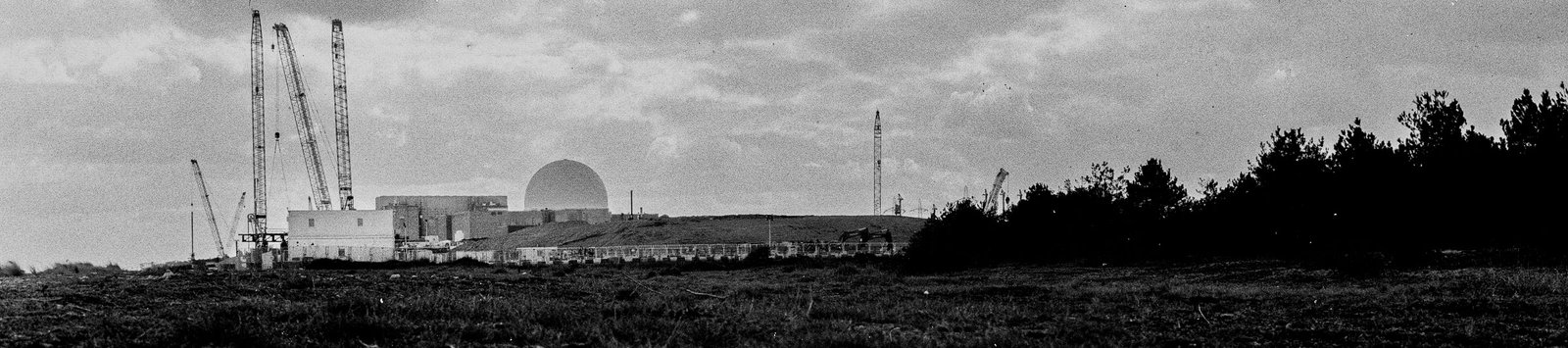
    As I approached Sizewell, driving through a landscape of red and white traffic cones, bare and scarred earth, heavy machinery and portakabins, the sense of destruction was still as palpable on this visit as it was previously.

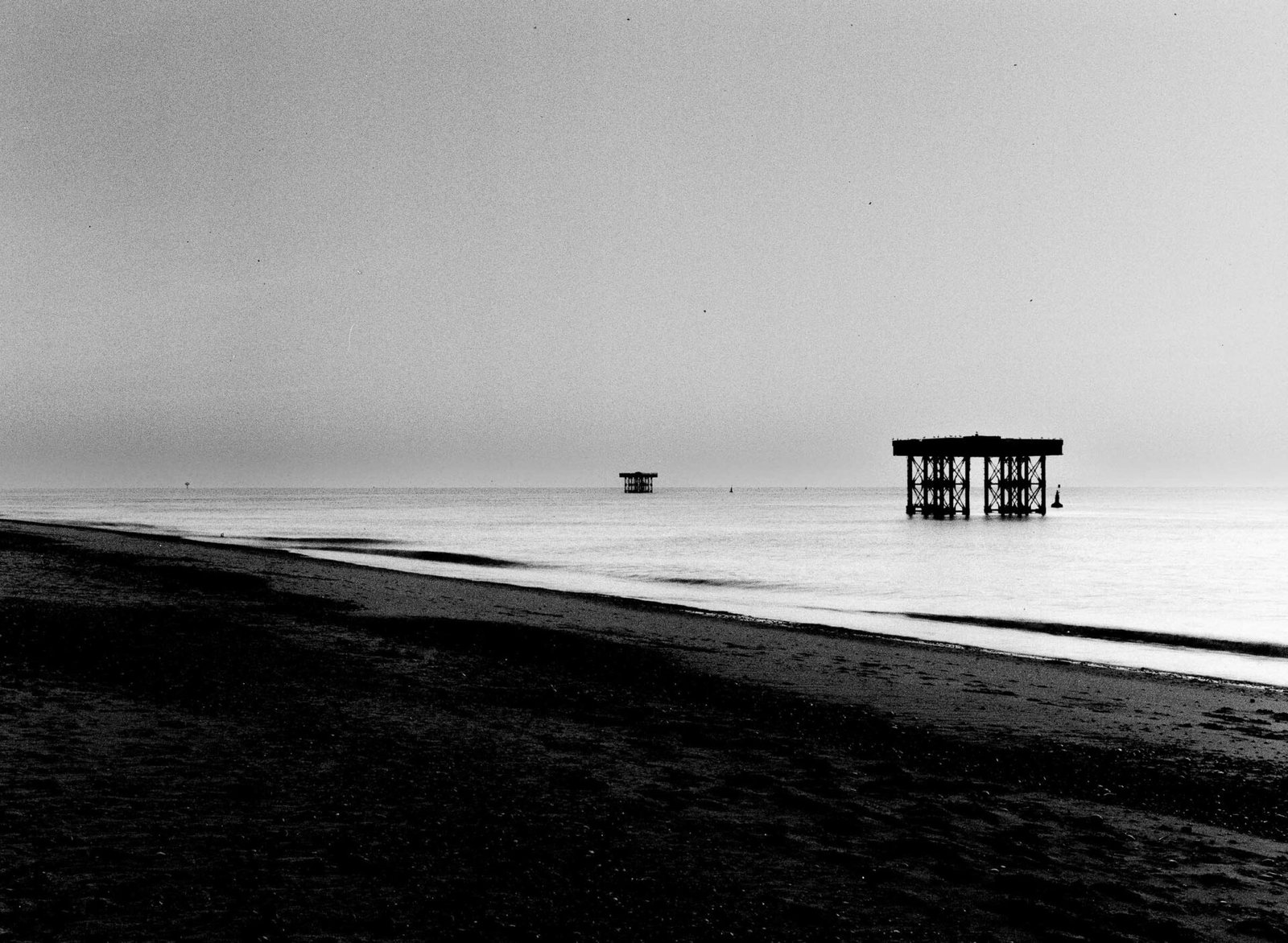
    Arriving at Sizewell Beach – the seafront onto which the nuclear reactors face, was, however, a slightly different experience. On the seaward side of the power station, save for a platform visible a few hundred meters out to sea, the impact of the construction work was much less tangible. The local cafe selling tea, cake and bacon butties was still very much in business. The car park had a splattering of empty cars, their owners out exercising their dogs on the beach.

    Two derelict industrial structures standing in a calm sea off Sizewell Beach, Suffolk, silhouetted against a pale sky
    Platforms in the North Sea

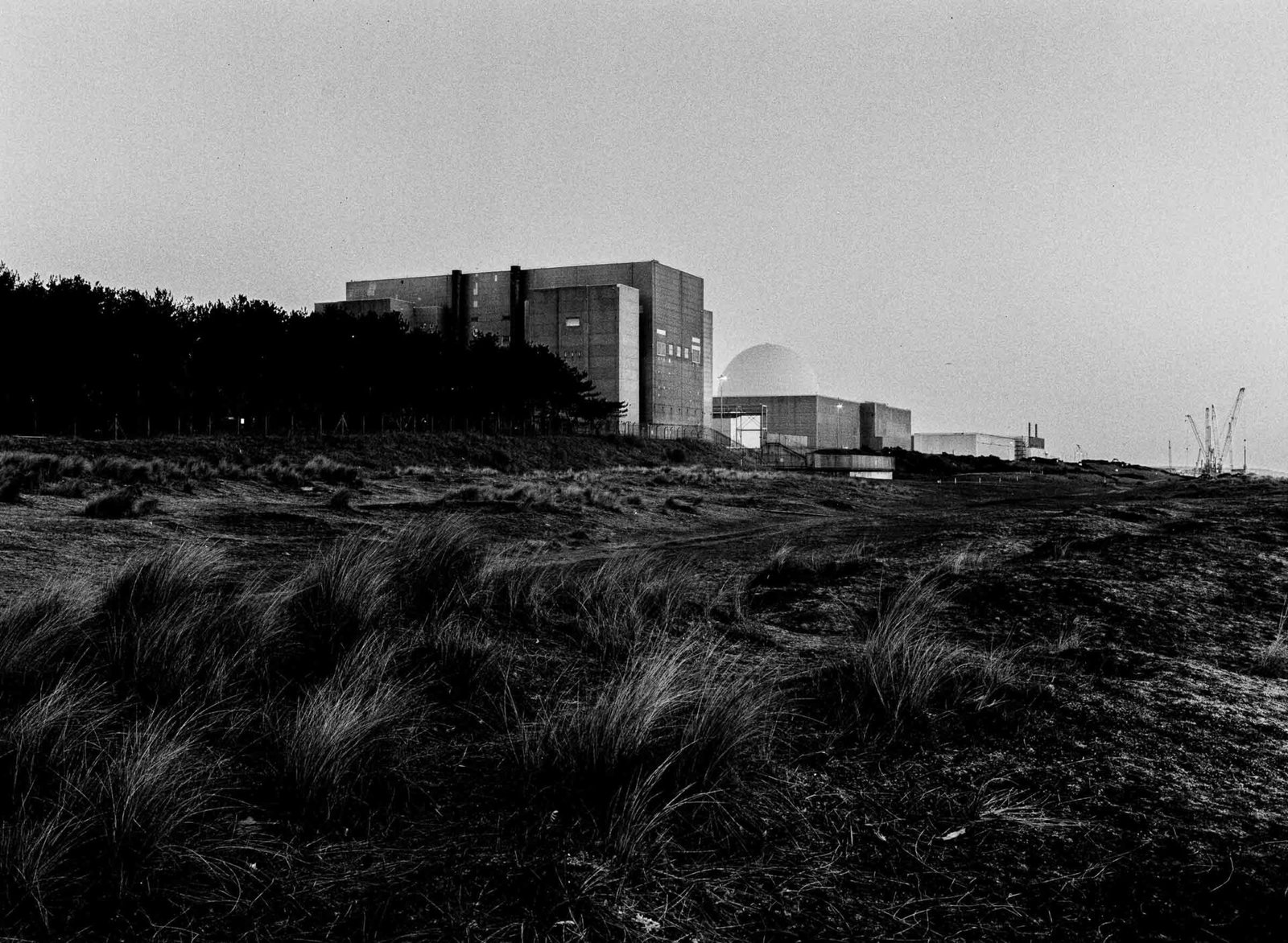
    Walking along the beach from the car park, I was surprised by just how close to Sizewell A and B you could get. Standing some 30 yards away from it, its concrete scale obscuring the Sun’s low trajectory in the early spring sky takes the breath away. Standing in its shadow is a visceral reminder of how small our footprint is as individuals, and yet how big our collective impact has been on the world we live in. Sizewell A is an old magnox type reactor that stopped producing power some 20 years ago yet still dominates the landscape for miles around.

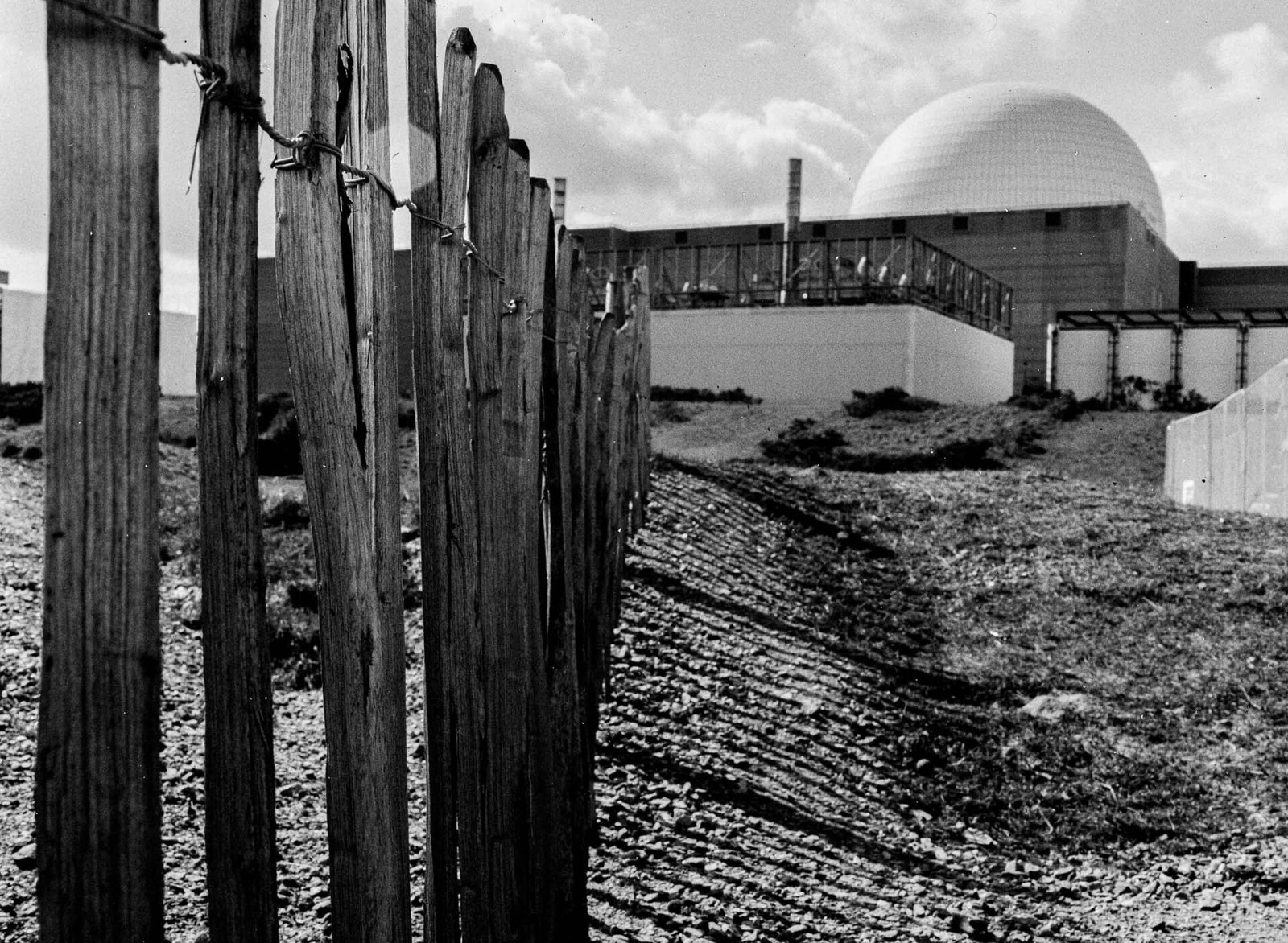
    Sizewell B is a more modern pressurised water reactor and is currently due to continue generating power until 2035. The B reactor is a different beast altogether. It looks like a giant golf ball, its sparkling white exterior almost luminescent in certain light. The reactor’s domed peak sits on top of a rectangle steel clad box, which has an uncanny resemblance to those monolithic distribution centres you often see just off motorway junctions.
    Weathered wooden fence posts on the shingle beach at Sizewell, with the luminescent dome of Sizewell B nuclear reactor behind
    Sizewell B

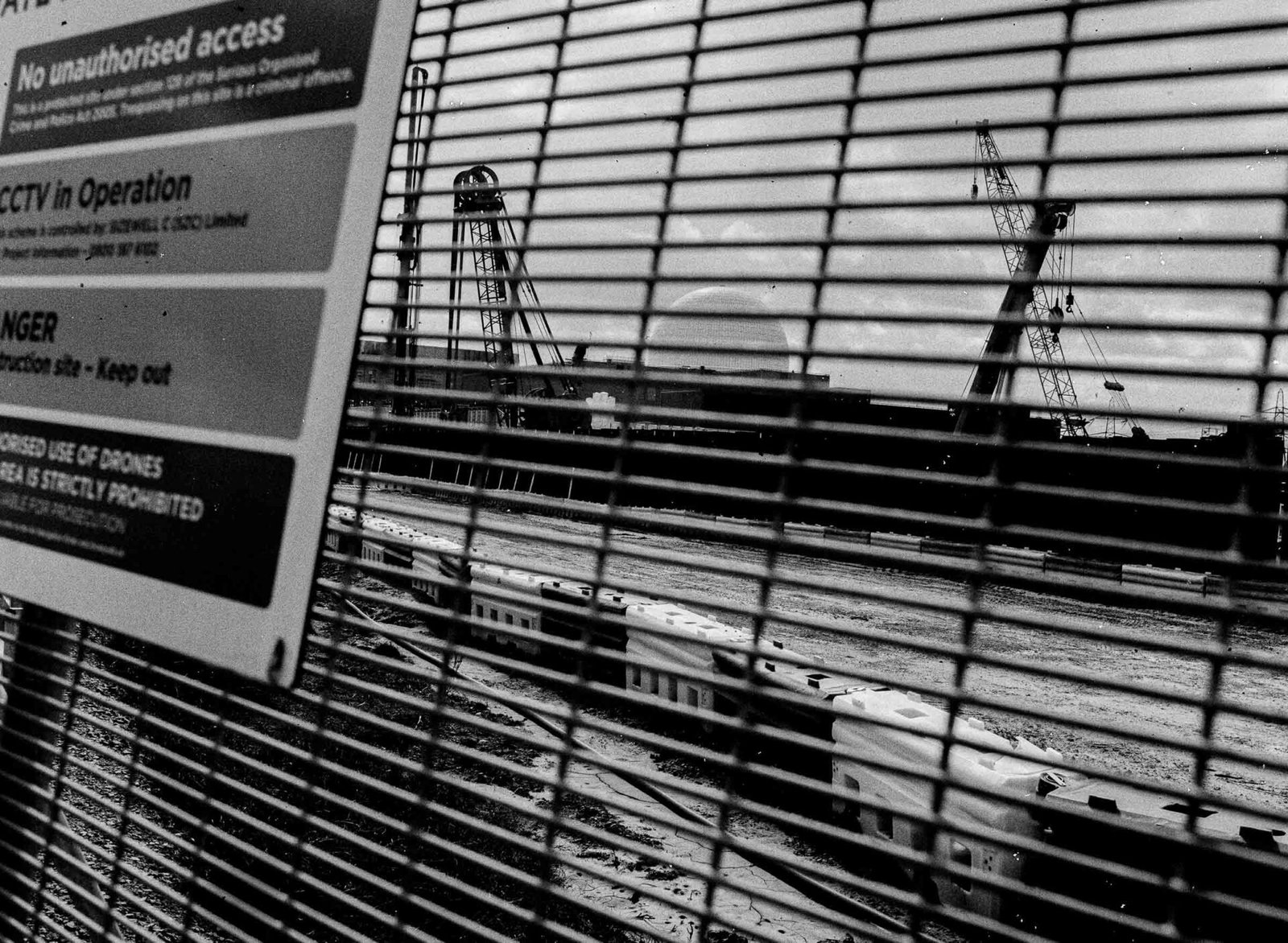
    But of course these two reactors are not the only story. Walk a little further north and you quickly encounter the main construction area for Sizewell C itself. The footprint of the construction work is easily two times the footprint of the current reactors put together. The perimeter fence is not easy to peer through, but you do nevertheless get a sense of the just how much man and machinery power is needed to construct a new nuclear reactor (or at least the type of new reactors we have chosen to commission here at Sizewell and at Hinckley Point in Somerset). The scale of the endeavour is undoubtedly huge.
    That scale is not easily captured through the lens of a camera and as I stared through my viewfinder trying to find an angle that would do it justice I was also left with a feeling of apprehension. When Sizewell C is finished what will its size be compared to the current reactors? A and B already dominate the relatively flat local landscape. The new reactor will undoubtedly be much bigger – how will it feel to walk through the otherwise tranquil local woodland and marshland, or along the beach in its shadow?

    The Sizewell C construction site viewed through a security fence, with warning signs visible and construction cranes and cleared earth behind the mesh
    Sizewell C construction

    The next day I took a different walk out to the coast hoping to get a sense of how the reactors fit into the broader landscape. I found myself arriving at the ruins of the old Leiston Abbey. The old abbey sits at the edge of Minsmere Marsh – a site of special scientific interest due to its unique and fragile coastal marshland environment and an RSPB reserve that is home to a number of endangered species.

    The old Abbey was originally only accessible by a causeway and surrounded by marshland and tidal waters. It originally stood as an island, isolated from the nearby communities of Sizewell and Dunwich. Those villages were much bigger in medieval times and much of them has been lost to coastal erosion (Dunwich was a thriving port town until the 14th century when much of the harbour was lost in a storm surge). The abbey itself had to move inland due to frequent storm surges and flooding. In fact, coastal erosion is very much still a fact of life on this coast; take a walk a bit further south along the coast at Thorpeness and you will see homes now abandoned precariously balanced on fast eroding cliffs.

    Circling the abbey’s ruined walls it still feels like you are somewhat isolated from the world around you. You can see how, in the 14th century, this would have been a peaceful and reflective space for the order that lived here. However, in the 21st century that feeling of isolation is rudely interrupted by the bright white dome of Sizewell B, looming menacingly in the distance along the coast. I wondered how much more visible and imposing Sizewell C would be in this vista, how it would alter the sense of peace I was still able to found in the shadow of the abbey ruins.

    The juxtaposition of an old, abandoned place of worship, its ruins gradually fading back into nature, and the reactors in the distance was jarring. The old abbey served a commitment to faith and a higher purpose. The reactors serve our belief in engineering and the generation of the power it takes to serve our modern religion of consumption.

    Sizewell A and B nuclear power stations seen from the dunes, with marram grass in the foreground and construction cranes visible to the right
    Sizewell A and B

    The viewfinder has a strange way of focusing your mind. The focus it brings sharpens your understanding of what you are seeing and the context in which you find it. As I framed the ruined abbey with the reactors in the background I was asking myself if there was a lesson here amongst the ruined abbey and neighbouring villages that have been slowly eaten away by the encroaching sea.

    Our engineering and technological hubris makes us feel all powerful. We have built these reactors and are building a new one right up against a fast-eroding coastline. Were the old ruins here and the lost houses and villages along the coast a warning that, no matter how omnipotent we think we are, no matter how much we think we can control the world around us, nature will always prevail?

    Sizewell B nuclear power station and its rectangular turbine hall framed between electricity pylons, with power lines crossing the sky
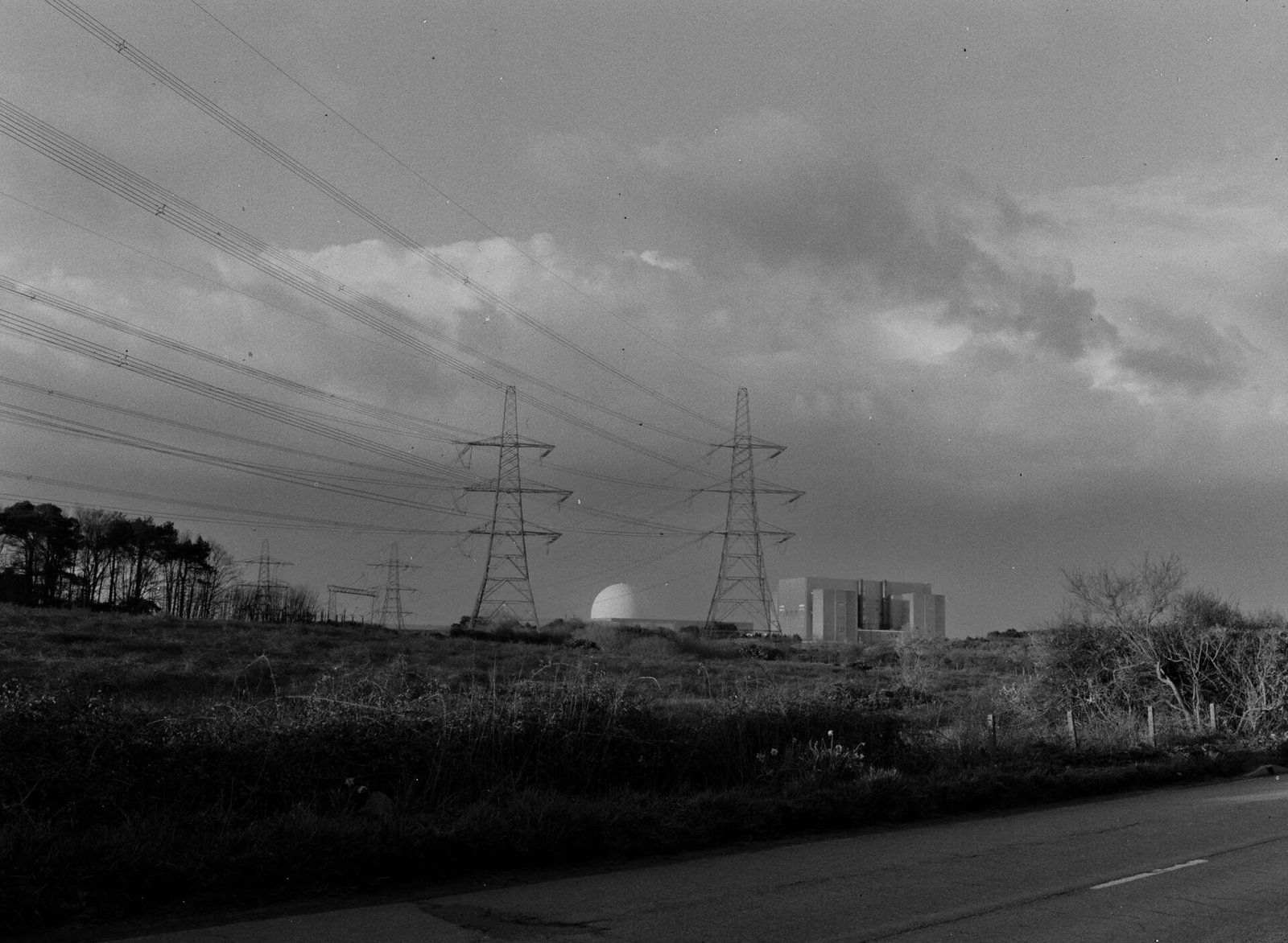
    The approach to Sizewell A and B
  • Framing

    Framing

    Those of you who have followed Frame to Grain for a while will know that I’ve increasingly focused my writing and photography on the infrastructure that we have constructed to supply our energy needs, and on our culture of consumption. This shift has been deliberate. The older I get the more I find myself asking questions about the impact that I as an individual, and we as a society, are having on the world that we live in.

    When I am out making pictures for Frame to Grain I am conscious that each time I look through my camera lens to capture a picture I am looking at a single and unique moment in time. This moment will never occur again, nobody will ever find the scene I am framing in my viewfinder exactly the same way as I find it at that moment. The uniqueness of that moment brings a certain degree of power and responsibility to me as a photographer. I have the ability to shape the story the viewer experiences by what I decide to frame through my lens. But framing is always an act of exclusion as well as inclusion. What I decide to leave out of the frame is just as important to the story I create as what I decide to include.

    As my interest in sustainability has grown I’ve begun to realise that the stories we are told about climate change work the same way. They are composed images, not neutral perspectives. Certain data is captured within the frame, certain data, where it doesn’t support the narrative sought, is cropped out.

    I recently read the excellent book Not the End of the World by Hannah Ritchie. It’s a great read about the actual science and fact behind the stories we are told about environmental sustainability and climate change. Ritchie is the Deputy Editor at Our World in Data, a highly influential online platform that brings together data and research on the world’s biggest challenges and makes it accessible for a general audience.

    Ritchie’s book brings a clarity and energy to the headlines we are often bombarded with about climate change and other sustainability matters. Her work helped me better understand what has been left out of the frame, what has been cropped. And it turns out that everything is not as bad or as clear cut as you might think.

    For example, we are told that emissions that cause climate change are accelerating. However, here’s what has been cropped out of the frame: our emissions per capita reached a peak in 2012 and have been slowly falling ever since. On an individual basis we now emit much less carbon than our parents or grandparents did, despite the myth that they lived much less energy intensive and frugal lives. In fact, in the UK each of us now emits about as much as somebody in the 1850s yet the energy efficient technology we now have access to enables us to have an immeasurably better standard of life.

    Of course that’s not all of the story. Even though the world has reached and passed peak birth rates (I was surprised to learn that we passed that point in 2017), the lag whilst those children grow up and live their lives means that the planet will not reach peak population size until the 2080s. That population growth means that even though emissions per capita are falling, gross worldwide emissions are still rising.

    What about on a more micro scale? We are told that we should eat organic food locally grown, or at the very least grown in the UK. But again, the dominant narrative has cropped some inconvenient data out of the frame.

    What the data actually tells us is that the transport element of our food chain only contributes about 5% of the total emissions caused by food production. And in fact most of that 5% comes from the emissions caused by lorry transport within a country ie. not the shipping itself (food that is sent by air has a different emissions profile). The rest of the emissions caused by food production come from land use change and emissions on the farm itself and, if you are trying to grow produce that is not native to the country in which you live – for example, trying to grow bananas in the UK, those emissions will be much higher.

    What about the myth that we don’t produce enough food to feed everyone in the world? Again, cropped. We actually produce enough to feed everyone alive today twice the daily recommended intake of calories.

    Ritchie is very keen to point out that this slightly more positive story is certainly not an excuse to stop doing the things we need to do to slow down climate change and environmental destruction. The consequences of not doing so will still be catastrophic. We feel and see this in our changing weather patterns, the plastic and litter washed up along the beaches that we stroll along, the latest headline we read about this or that species being in danger, the wild fire devastation we see in our news feeds.

    Frame to Grain is my attempt to compose honestly, to tell a story about the places I visit as I find them, to share with you what confirms but also what confounds or complicates the narratives we are told about our impact on the world.

    You will hopefully already have seen that what I see through my viewfinder sometimes triggers unexpected emotions in me – awe when I stood in the shadow of a nuclear reactor, or hope when I surveyed tens of thousands of shipping containers.

    There are no easy answers to many of the existential questions that I’ve been asking myself about climate change, our impact on the environment, the sustainability of the lives we all live, the footprint we leave behind. But the more I see, and the more I read, I realise that everything is not always as you first think. The frame we see is not always the whole story.

  • Stacked

    Stacked

    A crumbling Second World War concrete pillbox on the shingle beach at Felixstowe, with container ships and port cranes visible across the water
    Port cranes and World War II pillbox

    Look carefully at the small print of nearly anything you own or consume and you will find it was made somewhere on the far side of the world — Taiwan or China for electronics, Bangladesh or Turkey for clothes, Brazil or Colombia for the coffee in your cup. We all know we are part of a world economy, that very little we buy today is made in this country. But knowing that and truly grasping the physical scale of what it means are two very different things.

    It is only when I was up relatively close to the thousands of brightly coloured and stacked shipping containers, organised in neat rows, stretching in some cases as far as the eye can see, that you begin to realise the infrastructure that is required to keep our insatiable demand for cheap goods sated.

    The Port of Felixstowe, where the Orwell meets the sea on the Suffolk coast, is the UK’s largest container port — handling nearly half of Britain’s entire containerised trade. Its scale takes the breath away. Its 29 ship-to-shore gantry cranes, some reaching close to 50 metres above the quayside, dominate the local skyline for miles around, and at any one time the port has capacity to hold 152,000 containers stacked across its yards.

    Stacks of red and yellow shipping containers at the Port of Felixstowe, photographed on colour film
    Stack of shipping containers

    There’s a neatness and careful organisation to the stacked shipping containers that I see through my lens as a peer through the barbed wire fence that marks the perimeter of the port. This organisation is necessitated by the incredibly complex and precise logistics that make sure the cargo in each 12m by 2.4m steel box arrives exactly where we want it at the time we need it.

    Looking at each box, you cannot help but ask yourself what sits within? Where did it come from or what language were the makers speaking as they crafted or manufactured the cargo that it holds? Whose homes will the products it holds end up in, will they be able to contemplate the complex logistical operation that delivered their new toaster, their garden table, or their shiny new shoes to their homes?

    Photographed from a distance, there’s an almost toy-like aesthetic to the scene. Each colourful shipping container looks just like one of those 4 x 2 lego bricks that were the mainstay of any significant construction you made as a child. But then the dark grey of the cranes punctuates your childhood reminiscing, and reminds you that this scene conveys anything but child-like innocence.

    Spring blossom frames stacks of coloured shipping containers and gantry cranes at the Port of Felixstowe, Suffolk
    Harbour side views through spring blossom

    Each one of these boxes is a testament to consumption. The path that it took across the oceans of the world in the hull of a mega container ship is part of a chain of consumption that ties each of us to the world’s insatiable demand for resources. Each box represents an admission that we have built our lives around wanting and needing more stuff. You could argue whether this is a “need” created by corporate avarice rather than our own intrinsic desires, but we click on the buy button regardless, starting a chain of events that will ultimately end up in one of these boxes finding its way across the world to a harbour side such as Felixstowe.

    Of course that’s not the end of the story. These containers are then loaded onto a lorry or occasionally a freight train for onward transport to a distribution centre somewhere across the country. For those of us worried about our carbon footprint, I was surprised to learn that it was this part of the journey, tethered to the back of a HGV, that is the most carbon intensive of the container’s journey, a surprising fact when you consider that some of these boxes have travelled thousands of miles from the other side of the world.

    But once they are tethered to a HGV, the scale of the container shipping infrastructure we rely on so much is somehow lost as the lorries disperse across our trunk roads and motorways. It is here at a port like Felixstowe that you really feel the immense scale of the corporate consumption cycle that we are all a part of.

    A weathered yellow bollard in the foreground with rows of coloured shipping containers stacked behind at the Port of Felixstowe
    Shipping containers and bollard

    I must admit I expected to feel a degree of despair when I came to visit the port. I expected that I would feel shamed by what these thousands of shipping containers represented. I expected they would stir feelings of helplessness about the impact that our consumption culture is having on the planet.

    But instead I found myself surveying the scene through my camera lens with a feeling of awe and optimism. The lives we lead in different parts of the world are all interconnected, now more than ever. Every box captured in the viewfinder was a testament to our ability to cooperate together on a global scale. In today’s uncertain world that feels like something worth holding onto.

    A grid of blue, red and white OOCL shipping containers stacked at the Port of Felixstowe, Suffolk
    Grid of shipping containers
  • Half Life

    Half Life

    Empty road leading directly to Dungeness nuclear power station entrance, low angle perspective, road markings, Kent, black and white film photography
    Approach to Dungeness

    I can’t be the only one who finds themselves close to a nuclear power station and feels an underlying sense of unease.

    As I drove towards Dungeness on the south coast of Kent on a day filled with the optimism of early spring sunshine, the silhouette of the nuclear power generators rose in the foreground of my windscreen. With each mile closer I drove their foreboding presence gradually took up more of my field of view.

    Like many of a certain generation, I grew up with the spectre of the Chernobyl disaster in my consciousness. A catastrophic nuclear accident that left many dead, the health of many impacted for decades afterwards, an area the size of Greater London devastated and placed under permanent exclusion, uninhabitable to this day.

    And then there was Fukushima in Japan in 2011, a nuclear accident caused not by man’s error and a faulty design (as was largely the case with Chernobyl), but by a catastrophic earthquake and subsequent tsunami, one of the largest Japan has ever seen.

    These accidents are rightly emblazoned on our collective consciousness and feed a narrative which suggest nuclear energy is not safe.

    But like so much of what we’ve come to believe in the climate and energy debate, as I was walking around the now decommissioned nuclear power station with my camera, I found myself asking what was the reality and what is myth.

    The statistics, when you look at them properly, are striking. According to Our World in Data, coal causes around 25 deaths per terawatt-hour of electricity produced — the majority from air pollution rather than accidents. Nuclear causes 0.03 deaths per terawatt-hour. Even wind energy, which most of us instinctively feel comfortable with, causes slightly more deaths per unit of electricity than nuclear — from turbine accidents and offshore incidents. Nuclear results in 99.8% fewer deaths than coal. The accidents we carry in our collective memory — Chernobyl, Fukushima — are real and their consequences serious. But they are, statistically, anomalies in a safety record that no fossil fuel can come close to matching.

    Abandoned metal frame structure on Dungeness shingle headland with nuclear power station and electricity pylons, panoramic black and white film photography, Kent
    Dungeness B from the West

    Perhaps the unease that we feel about nuclear is – when looked at rationally – unfounded. But as I spent some time walking around the now decommissioned nuclear reactors, I wondered if there was something else underpinning the unease.

    These generators are enormous. Dungeness A and B are imposing, brutalist concrete megaliths. They utterly dominate the flat marsh and scrubland on which they are situated. For miles around, every glance that remotely looks in their direction is immediately rudely interrupted by their presence.

    They feel like a backdrop to a dystopian sci-fi film, their 1960’s aesthetic like something you could almost feel described in an Asimov novel.

    But spend a bit of time with them and you come to appreciate that they are also beautiful in their own way. Their clean concrete lines speak to the wonders of engineering that lie within. Their sheer scale leave you awestruck at the technological achievements they house. They are monuments to our mastery of the atom – the very building block of the universe.

    The tension between our unease about nuclear, and the admiration you cannot help but have for the engineering and architectural achievement, are mirrored in the juxtaposition of these enormous reactors and the landscape in which they are situated.

    It is this tension and how landscapes like this make us feel that is at the heart of what interests me as a photographer.

    Dungeness has an end of the world feel to it. The large expanse of scrub (technically Britain’s only desert) which reaches back from the shingle beach is punctuated by wooden shacks, the odd marooned boat that now feels impossible far from the sea, and long forgotten remnants of the fishing industry.

    Washing line with clothes drying in front of Dungeness nuclear power station, shingle beach fisherman's hut, Kent, documentary photography
    Fisherman’s hut and washing drying in the shadow of Dungeness

    There’s a palpable sense of the alternative to the the dwellings you come across, each home here cobbled together, in the shadow of the reactors, almost as a statement of quiet defiance. As I see someone’s washing fluttering in the wind I ask myself how I would feel living in the shadow of a nuclear reactor

    Walking the fenced perimeter across the lunar-esque landscape that surrounds Dungeness A and B, you feel a strong sense both of how much we have achieved in the name of science and progress, but also how much that progress has impacted our environment.

    The high fencing and warning signs that surround the site feel almost futile. These monoliths impose themselves on everyone and everything that surrounds them. Yet photographing the reactors from a distance and through barbed wire fencing contributes to a feeling that these edifices are somehow not for us or of our time. And that, of course, is true.

    Both reactors are now decommissioned. They are a relic of a different time. They generated electricity for nearly 60 years between them. Some estimate that it will take nearly 100 years for the site to be returned back to its original pre-construction state (although there is some talk of building a new reactor on the same site).

    100 years is a long time. What does that say about the care we have for our environment when it will take nearly twice as long to erase the scars of our progress as it did for these generators to be useful to us?

    What world will this space form part of in 100 years time? Where will our desire for ever more stuff and ever more energy to power our stuff take us? What evidence will remain on this remote bit of scrubland of man’s ability to split a heavy uranium atom to power our lives?

    Dungeness B nuclear power station viewed through chain-link fence, boundary of nuclear licensed site sign, Kent, black and white film photography
    Dungeness B boundary fence