Category: Essays

  • Stacked

    Stacked

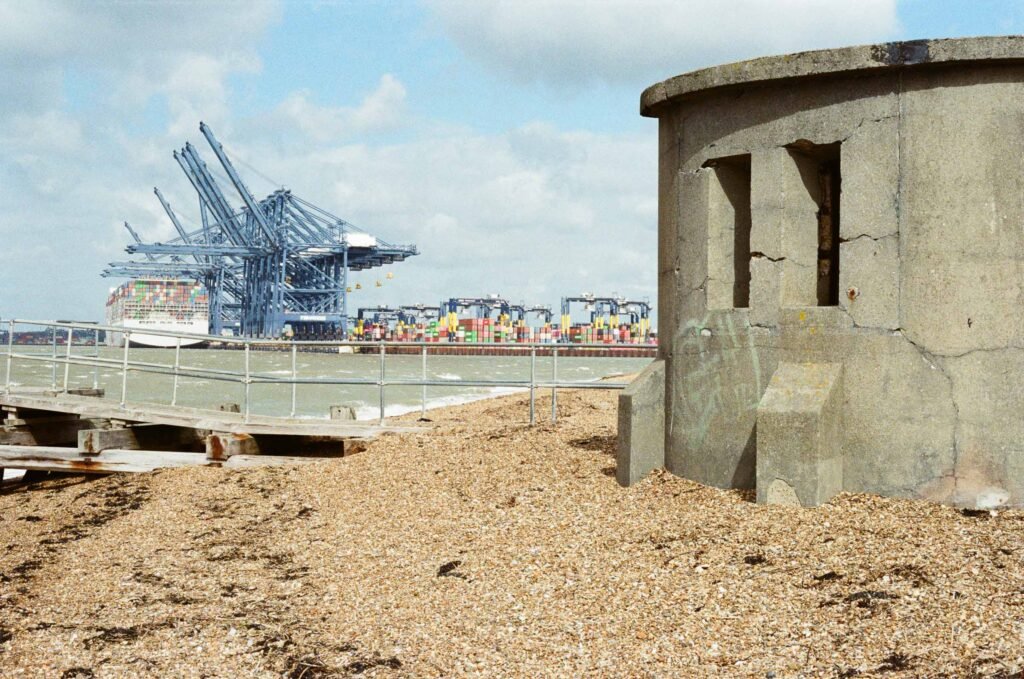
    A crumbling Second World War concrete pillbox on the shingle beach at Felixstowe, with container ships and port cranes visible across the water
    Port cranes and World War II pillbox

    Look carefully at the small print of nearly anything you own or consume and you will find it was made somewhere on the far side of the world — Taiwan or China for electronics, Bangladesh or Turkey for clothes, Brazil or Colombia for the coffee in your cup. We all know we are part of a world economy, that very little we buy today is made in this country. But knowing that and truly grasping the physical scale of what it means are two very different things.

    It is only when I was up relatively close to the thousands of brightly coloured and stacked shipping containers, organised in neat rows, stretching in some cases as far as the eye can see, that you begin to realise the infrastructure that is required to keep our insatiable demand for cheap goods sated.

    The Port of Felixstowe, where the Orwell meets the sea on the Suffolk coast, is the UK’s largest container port — handling nearly half of Britain’s entire containerised trade. Its scale takes the breath away. Its 29 ship-to-shore gantry cranes, some reaching close to 50 metres above the quayside, dominate the local skyline for miles around, and at any one time the port has capacity to hold 152,000 containers stacked across its yards.
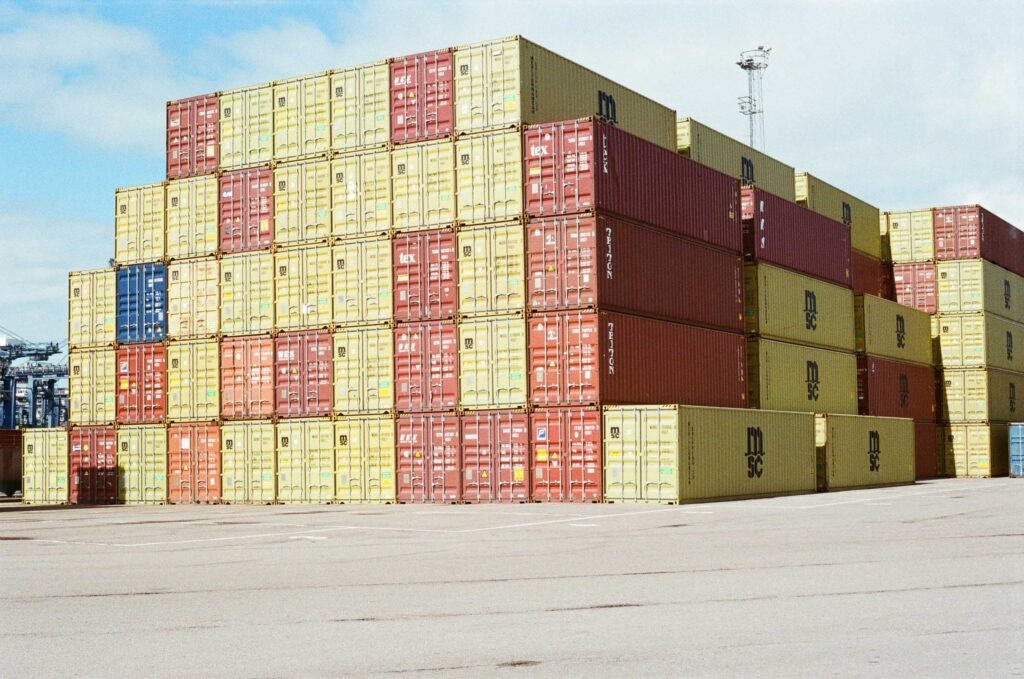
    Stacks of red and yellow shipping containers at the Port of Felixstowe, photographed on colour film
    Stack of shipping containers

    There’s a neatness and careful organisation to the stacked shipping containers that I see through my lens as a peer through the barbed wire fence that marks the perimeter of the port. This organisation is necessitated by the incredibly complex and precise logistics that make sure the cargo in each 12m by 2.4m steel box arrives exactly where we want it at the time we need it.

    Looking at each box, you cannot help but ask yourself what sits within? Where did it come from or what language were the makers speaking as they crafted or manufactured the cargo that it holds? Whose homes will the products it holds end up in, will they be able to contemplate the complex logistical operation that delivered their new toaster, their garden table, or their shiny new shoes to their homes?

    Photographed from a distance, there’s an almost toy-like aesthetic to the scene. Each colourful shipping container looks just like one of those 4 x 2 lego bricks that were the mainstay of any significant construction you made as a child. But then the dark grey of the cranes punctuates your childhood reminiscing, and reminds you that this scene conveys anything but child-like innocence.
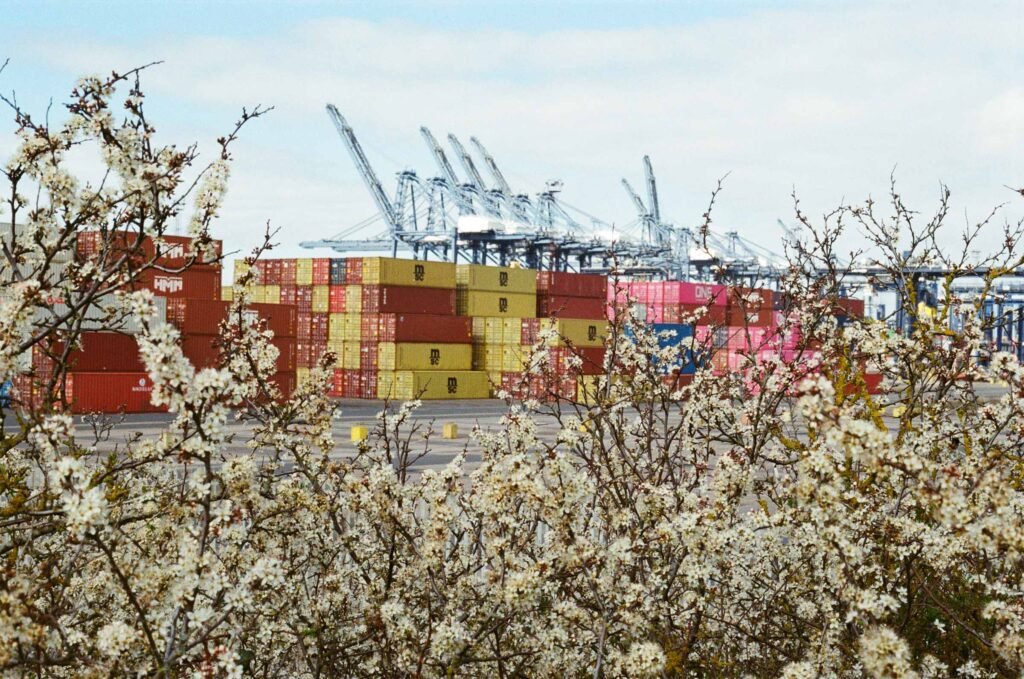
    Spring blossom frames stacks of coloured shipping containers and gantry cranes at the Port of Felixstowe, Suffolk
    Harbour side views through spring blossom

    Each one of these boxes is a testament to consumption. The path that it took across the oceans of the world in the hull of a mega container ship is part of a chain of consumption that ties each of us to the world’s insatiable demand for resources. Each box represents an admission that we have built our lives around wanting and needing more stuff. You could argue whether this is a “need” created by corporate avarice rather than our own intrinsic desires, but we click on the buy button regardless, starting a chain of events that will ultimately end up in one of these boxes finding its way across the world to a harbour side such as Felixstowe.

    Of course that’s not the end of the story. These containers are then loaded onto a lorry or occasionally a freight train for onward transport to a distribution centre somewhere across the country. For those of us worried about our carbon footprint, I was surprised to learn that it was this part of the journey, tethered to the back of a HGV, that is the most carbon intensive of the container’s journey, a surprising fact when you consider that some of these boxes have travelled thousands of miles from the other side of the world.

    But once they are tethered to a HGV, the scale of the container shipping infrastructure we rely on so much is somehow lost as the lorries disperse across our trunk roads and motorways. It is here at a port like Felixstowe that you really feel the immense scale of the corporate consumption cycle that we are all a part of.
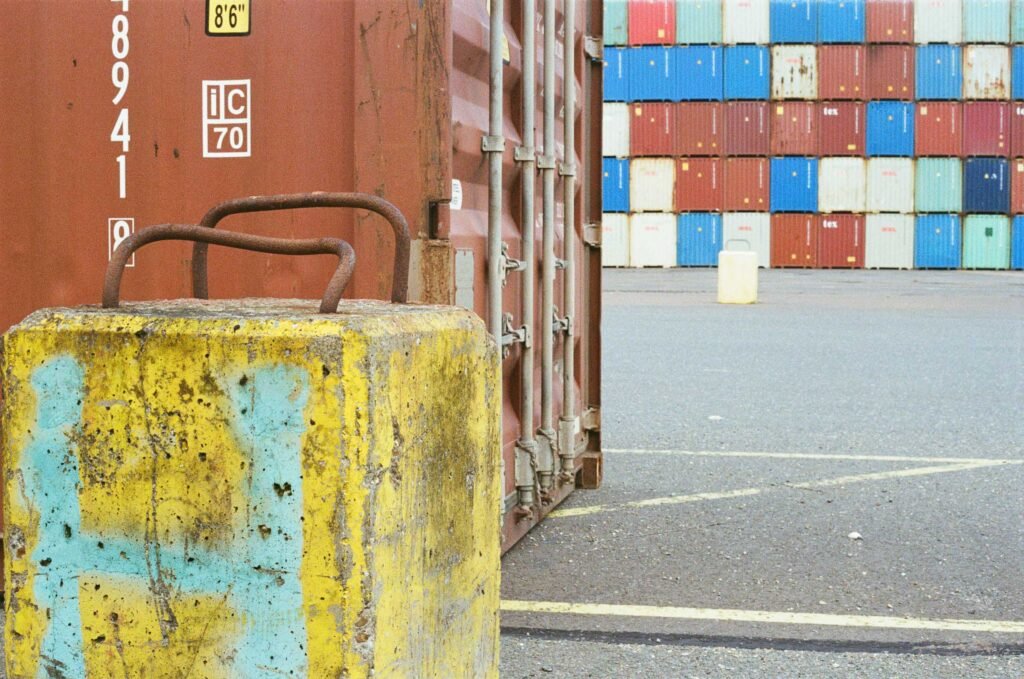
    A weathered yellow bollard in the foreground with rows of coloured shipping containers stacked behind at the Port of Felixstowe
    Shipping containers and bollard

    I must admit I expected to feel a degree of despair when I came to visit the port. I expected that I would feel shamed by what these thousands of shipping containers represented. I expected they would stir feelings of helplessness about the impact that our consumption culture is having on the planet.

    But instead I found myself surveying the scene through my camera lens with a feeling of awe and optimism. The lives we lead in different parts of the world are all interconnected, now more than ever. Every box captured in the viewfinder was a testament to our ability to cooperate together on a global scale. In today’s uncertain world that feels like something worth holding onto.
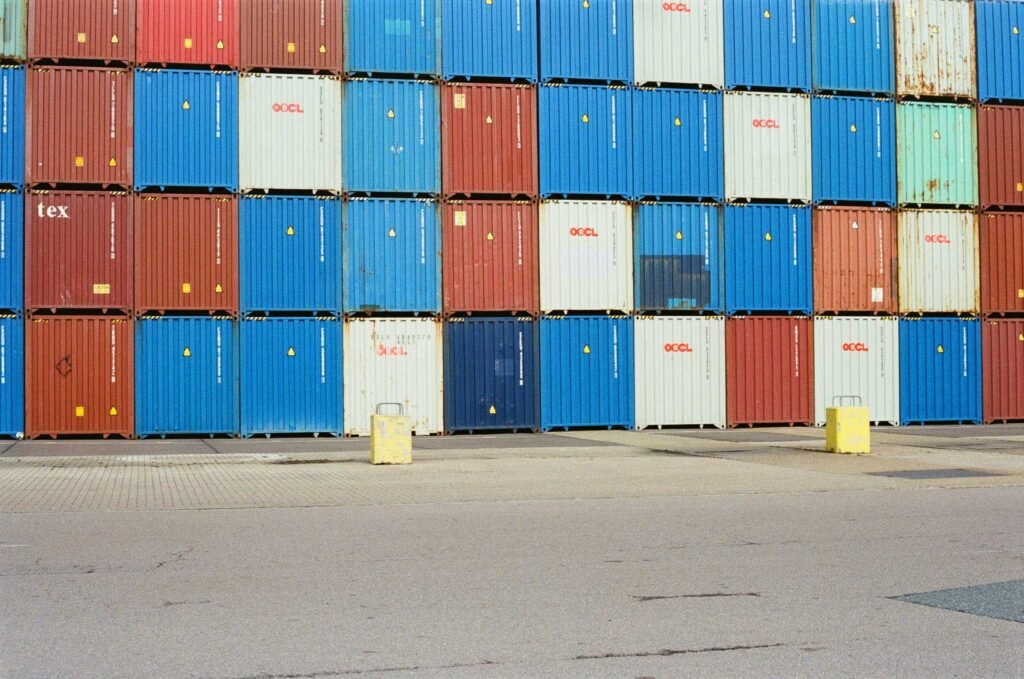
    A grid of blue, red and white OOCL shipping containers stacked at the Port of Felixstowe, Suffolk
    Grid of shipping containers
  • Half Life

    Half Life

    Empty road leading directly to Dungeness nuclear power station entrance, low angle perspective, road markings, Kent, black and white film photography
    Approach to Dungeness

    I can’t be the only one who finds themselves close to a nuclear power station and feels an underlying sense of unease.

    As I drove towards Dungeness on the south coast of Kent on a day filled with the optimism of early spring sunshine, the silhouette of the nuclear power generators rose in the foreground of my windscreen. With each mile closer I drove their foreboding presence gradually took up more of my field of view.

    Like many of a certain generation, I grew up with the spectre of the Chernobyl disaster in my consciousness. A catastrophic nuclear accident that left many dead, the health of many impacted for decades afterwards, an area the size of Greater London devastated and placed under permanent exclusion, uninhabitable to this day.

    And then there was Fukushima in Japan in 2011, a nuclear accident caused not by man’s error and a faulty design (as was largely the case with Chernobyl), but by a catastrophic earthquake and subsequent tsunami, one of the largest Japan has ever seen.

    These accidents are rightly emblazoned on our collective consciousness and feed a narrative which suggest nuclear energy is not safe.

    But like so much of what we’ve come to believe in the climate and energy debate, as I was walking around the now decommissioned nuclear power station with my camera, I found myself asking what was the reality and what is myth.

    The statistics, when you look at them properly, are striking. According to Our World in Data, coal causes around 25 deaths per terawatt-hour of electricity produced — the majority from air pollution rather than accidents. Nuclear causes 0.03 deaths per terawatt-hour. Even wind energy, which most of us instinctively feel comfortable with, causes slightly more deaths per unit of electricity than nuclear — from turbine accidents and offshore incidents. Nuclear results in 99.8% fewer deaths than coal. The accidents we carry in our collective memory — Chernobyl, Fukushima — are real and their consequences serious. But they are, statistically, anomalies in a safety record that no fossil fuel can come close to matching.

    Abandoned metal frame structure on Dungeness shingle headland with nuclear power station and electricity pylons, panoramic black and white film photography, Kent
    Dungeness B from the West

    Perhaps the unease that we feel about nuclear is – when looked at rationally – unfounded. But as I spent some time walking around the now decommissioned nuclear reactors, I wondered if there was something else underpinning the unease.

    These generators are enormous. Dungeness A and B are imposing, brutalist concrete megaliths. They utterly dominate the flat marsh and scrubland on which they are situated. For miles around, every glance that remotely looks in their direction is immediately rudely interrupted by their presence.

    They feel like a backdrop to a dystopian sci-fi film, their 1960’s aesthetic like something you could almost feel described in an Asimov novel.

    But spend a bit of time with them and you come to appreciate that they are also beautiful in their own way. Their clean concrete lines speak to the wonders of engineering that lie within. Their sheer scale leave you awestruck at the technological achievements they house. They are monuments to our mastery of the atom – the very building block of the universe.

    The tension between our unease about nuclear, and the admiration you cannot help but have for the engineering and architectural achievement, are mirrored in the juxtaposition of these enormous reactors and the landscape in which they are situated.

    It is this tension and how landscapes like this make us feel that is at the heart of what interests me as a photographer.

    Dungeness has an end of the world feel to it. The large expanse of scrub (technically Britain’s only desert) which reaches back from the shingle beach is punctuated by wooden shacks, the odd marooned boat that now feels impossible far from the sea, and long forgotten remnants of the fishing industry.

    Washing line with clothes drying in front of Dungeness nuclear power station, shingle beach fisherman's hut, Kent, documentary photography
    Fisherman’s hut and washing drying in the shadow of Dungeness

    There’s a palpable sense of the alternative to the the dwellings you come across, each home here cobbled together, in the shadow of the reactors, almost as a statement of quiet defiance. As I see someone’s washing fluttering in the wind I ask myself how I would feel living in the shadow of a nuclear reactor

    Walking the fenced perimeter across the lunar-esque landscape that surrounds Dungeness A and B, you feel a strong sense both of how much we have achieved in the name of science and progress, but also how much that progress has impacted our environment.

    The high fencing and warning signs that surround the site feel almost futile. These monoliths impose themselves on everyone and everything that surrounds them. Yet photographing the reactors from a distance and through barbed wire fencing contributes to a feeling that these edifices are somehow not for us or of our time. And that, of course, is true.

    Both reactors are now decommissioned. They are a relic of a different time. They generated electricity for nearly 60 years between them. Some estimate that it will take nearly 100 years for the site to be returned back to its original pre-construction state (although there is some talk of building a new reactor on the same site).

    100 years is a long time. What does that say about the care we have for our environment when it will take nearly twice as long to erase the scars of our progress as it did for these generators to be useful to us?

    What world will this space form part of in 100 years time? Where will our desire for ever more stuff and ever more energy to power our stuff take us? What evidence will remain on this remote bit of scrubland of man’s ability to split a heavy uranium atom to power our lives?

    Dungeness B nuclear power station viewed through chain-link fence, boundary of nuclear licensed site sign, Kent, black and white film photography
    Dungeness B boundary fence